
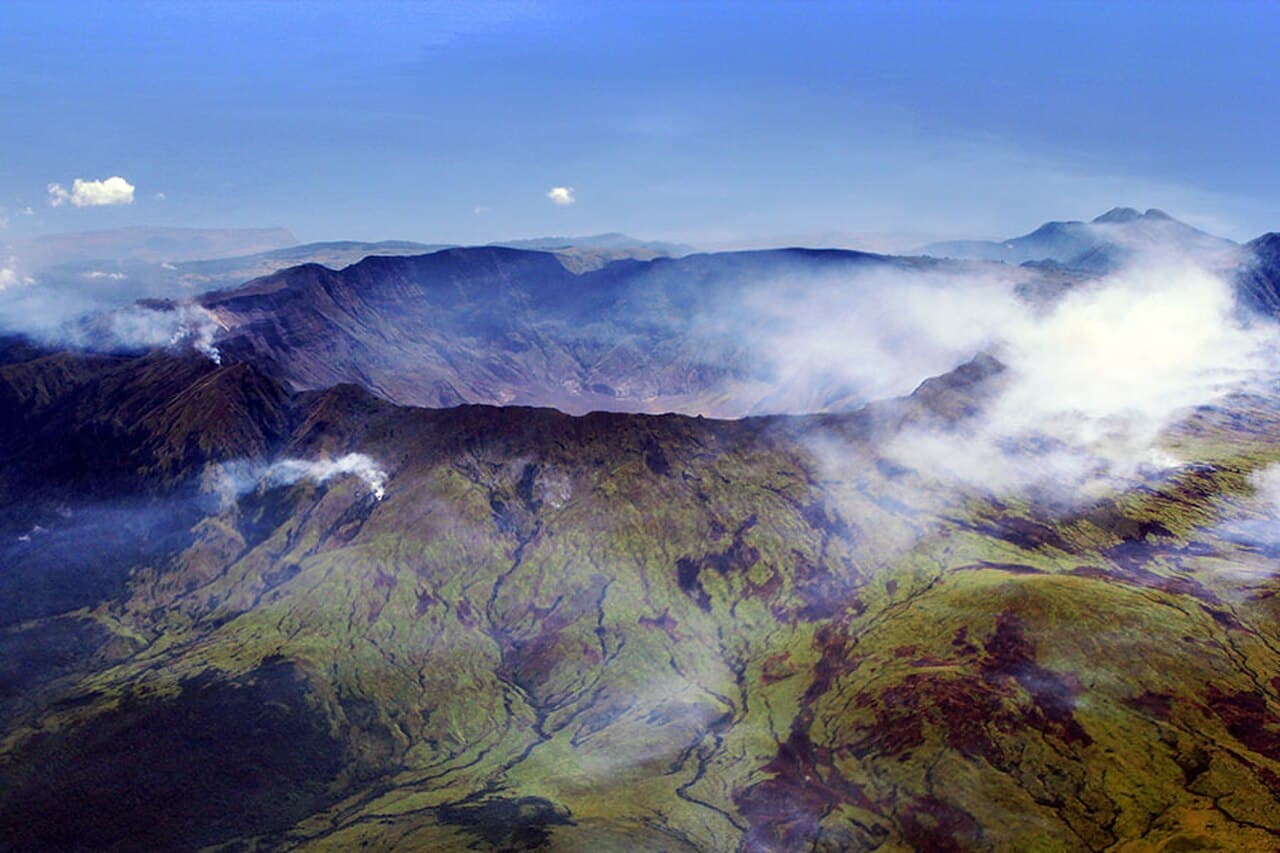
On the morning of 5 April 1815, the island of Sumbawa in the Dutch East Indies, known today as Indonesia, became the stage for a geological event that would reverberate across the globe. Mount Tambora, a towering stratovolcano rising to about 4,000 metres, commenced an eruption of unprecedented scale. By 10 April, the eruption reached its paroxysmal phase, culminating in a cataclysmic event that saw the mountain's summit reduced to 2,851 metres above sea level. An estimated 175 cubic kilometres of rock and ash were expelled into the atmosphere. This eruption remains the largest volcanic event in recorded human history, dwarfing the later Krakatoa eruption of 1883 by a factor of ten and exceeding the 1991 Pinatubo eruption by a magnitude of four. The immediate devastation was catastrophic, with around seventy thousand people perishing on Sumbawa and nearby islands due to pyroclastic flows, tsunamis, and subsequent famine. The eruption was meticulously recorded by British colonial administrators in Java, European trading ships traversing the Java Sea, and has been corroborated by climate proxies such as tree rings and ice cores. Yet its most profound legacy would be felt far beyond the immediate vicinity, as its atmospheric effects disrupted the climate across the northern hemisphere for years to come.
What a tropical eruption does to the planet
When a volcano erupts, it injects vast quantities of ash and gas into the atmosphere. While ash may settle within weeks, sulphur dioxide (SO2) remains, reacting with water vapour in the stratosphere to form sulphate aerosols—tiny droplets that scatter sunlight and reduce solar energy reaching the Earth's surface. Tambora's eruption injected approximately 60 to 100 megatonnes of SO2 into the stratosphere, creating a sun-blocking veil of sulphate aerosols. This figure represents about double the load that resulted in global cooling after the Pinatubo eruption. Because Tambora erupted near the equator, the stratospheric circulation efficiently dispersed the aerosol veil into both hemispheres within a few months. By autumn 1815, the entire upper atmosphere was shrouded, casting vivid sunsets that caught the attention of contemporary painters such as J.M.W. Turner. Turner's work from 1815 to 1820 captures unusually vivid skies, a phenomenon later attributed by 21st-century atmospheric-physics studies to the aerosol load from Tambora.
The immediate climatic impact was a significant drop in average surface temperatures across the northern hemisphere. In 1816, temperatures fell by approximately 0.5 to 1°C—a seemingly modest decline that masked the catastrophic impact on agriculture. The growing season in temperate latitudes was severely disrupted, leading to widespread agricultural failures and food shortages. This event, known as "The Year Without a Summer," would leave an indelible mark on societies across the globe.
What the cold actually did
The summer of 1816 was anything but normal. Quebec City was blanketed by a foot of snow in June, an anomaly that was repeated with devastating effects across New England, where frost in July destroyed corn and wheat crops from Vermont to Maine. Some villages saw their entire harvests wiped out. In Switzerland, particularly in the Jura region, it was the coldest summer of the 19th century. Rainfall in June and July was four times the norm, decimating the wheat harvest and tripling bread prices in Geneva.
Ireland faced a grim scenario as well. The staple crop for the rural poor, the potato, succumbed to the wet and cold, leading to crop failures. This spurred a typhus epidemic from 1816 to 1819, resulting in the deaths of an estimated 65,000 to 100,000 people. In China's Yunnan province, the monsoon failed, causing a rice crop collapse for three consecutive years, which led to famine and forced migration that emptied entire valleys. Across Europe and the eastern United States, the wheat harvest was decimated to a third or half of its usual yield, driving food prices to famine levels reminiscent of the 1790s. Riots broke out in Wales, Lyon, and the German states, prompting unprecedented charity distributions and the establishment of the first state-managed food-relief network in Prussia.
Switzerland in June
High above Lake Geneva, the Villa Diodati stands as a silent witness to history. In May 1816, this residence was rented by the English poet Lord Byron, who was escaping scandal in England. Accompanied by his physician John Polidori, Byron was soon joined by Percy Bysshe Shelley, Mary Wollstonecraft Godwin (later Mary Shelley), and her stepsister Claire Clairmont. The weather in Geneva that June was unforgiving, with rain and cold confining the group indoors. It was during one such stormy evening, on 17 June, that Byron suggested they each write a ghost story.
Mary Shelley began crafting a narrative about a scientist who animates dead flesh, a story that would mature into 'Frankenstein; or, The Modern Prometheus', first published anonymously in 1818. Polidori, inspired by the same suggestion, wrote 'The Vampyre', published in 1819. These works emerged from an environment of unseasonal weather, a direct legacy of the Tambora eruption, demonstrating how the climate anomaly spurred literary innovation. Both texts are foundational in their respective genres, with 'Frankenstein' continuing to be a touchstone in discussions of science and ethics, while 'The Vampyre' set the stage for the modern vampire genre, influencing Bram Stoker's later work on Dracula.
What the period understood
Contemporaries of the 1816 climatic anomaly were unaware of its volcanic origin. Reports of the Tambora eruption reached European newspapers in late 1815 through British colonial accounts from Java, yet these articles failed to link the event to the subsequent weather changes. Explanations for the bizarre climate ranged from the supernatural to pseudoscientific; some blamed comets or sunspots, while others invoked divine wrath or strange electrical disturbances. The connections that seem so obvious now were hidden by the limits of contemporary understanding.
Benjamin Franklin's 1784 suggestion, that the cold European summers following the 1783-1784 Laki eruption were due to volcanic ash, was pioneering, yet it failed to shift scientific consensus at the time. It wasn't until the late 19th century that Sir Norman Lockyer revisited such theories, and it was Hubert Lamb in the mid-20th century who firmly established the link between Tambora's eruption and the anomalous weather of 1816. For those living through it, such as the families queuing for scarce bread or the audiences of the new literary creations, the connection between a distant volcano and their immediate reality was a mystery.
What followed
The catastrophic events of 1816 accelerated pre-existing trends and initiated new ones. As food prices soared, agricultural practices began to shift. Farmers diversified crops to avoid future single-crop dependencies, and potatoes gained popularity as a resilient staple in northern Europe. The Prussian state, along with others like the Netherlands and parts of Italy, began to explore state-level food policy interventions for the first time.
These shifts were not confined to Europe. Emigration from Europe to the United States surged between 1816 and 1818, representing one of the largest waves before the advent of the railroad. This movement reshaped the demographics of states like Vermont, New Hampshire, and upstate New York, areas particularly hard-hit by the cold summer. The scientific study of climate also advanced, as meteorological journals meticulously recorded the unusual weather, data that remains a valuable resource for modern paleoclimate research. Artistically, the apocalyptic tone in early 19th-century European art, exemplified by John Martin's vast paintings and Turner's late sunsets, drew inspiration from the public's brush with an actual climatic crisis.
The smaller story inside the big one
In the shadow of global events, individual lives and local histories took shape in ways often obscured by the larger narrative. In June 1817, on the shores of Lake Geneva, Jakob Burckhardt was born in Basel. This Swiss historian would later author 'The Civilization of the Renaissance in Italy', shaping our understanding of cultural history. In Sumbawa, the recovery from Tambora was slow; decades passed before communities rebuilt, with local traditions preserving the memory of the eruption well into the 20th century.
In the United States, the crop failures contributed to the religious fervour of the Second Great Awakening, a movement that historians like Nathan Hatch and Christine Heyrman link to the socioeconomic strains of the time. In China, the Yunnan famine permanently altered agricultural landscapes; some terraced fields recorded as productive before 1816 were never restored. Each of these stories reflects the profound impact that Tambora's eruption had on individual lives and communities—a collection of smaller narratives that collectively illuminate the broader consequences of climate upheaval.
Today, the Tambora eruption is an exemplary case in climate science, studied for its atmospheric impacts and global consequences. Its caldera, now a national park, invites climbers to witness the scale of its 1815 legacy firsthand. Tree rings from regions as diverse as Patagonia and Scandinavia, and ice cores from polar caps, all bear testament to the climatic shock of that year. The connection between Tambora, weather anomalies, social unrest, cultural shifts, and scientific advancements is unusually clear and traceable. Those who lived through it did not have the benefit of this clarity. They saw their world change, and with the tools available to them—be it astrology, theology, or the dark imaginings of a stormy night—they sought to make sense of the inexplicable. In doing so, they left a legacy that continues to inform our understanding of how intertwined the threads of climate and human society truly are.
References
- Wood, G. D. (2014). Tambora: The Eruption That Changed the World. Princeton University Press.
- Stommel, H., & Stommel, E. (1979). The year without a summer. Scientific American, 240(6), 176–186.
- Oppenheimer, C. (2003). Climatic, environmental and human consequences of the largest known historic eruption: Tambora volcano (Indonesia) 1815. Progress in Physical Geography, 27(2), 230–259.
- Klingaman, W. K., & Klingaman, N. P. (2013). The Year Without Summer: 1816 and the Volcano That Darkened the World and Changed History. St. Martin's Press.


