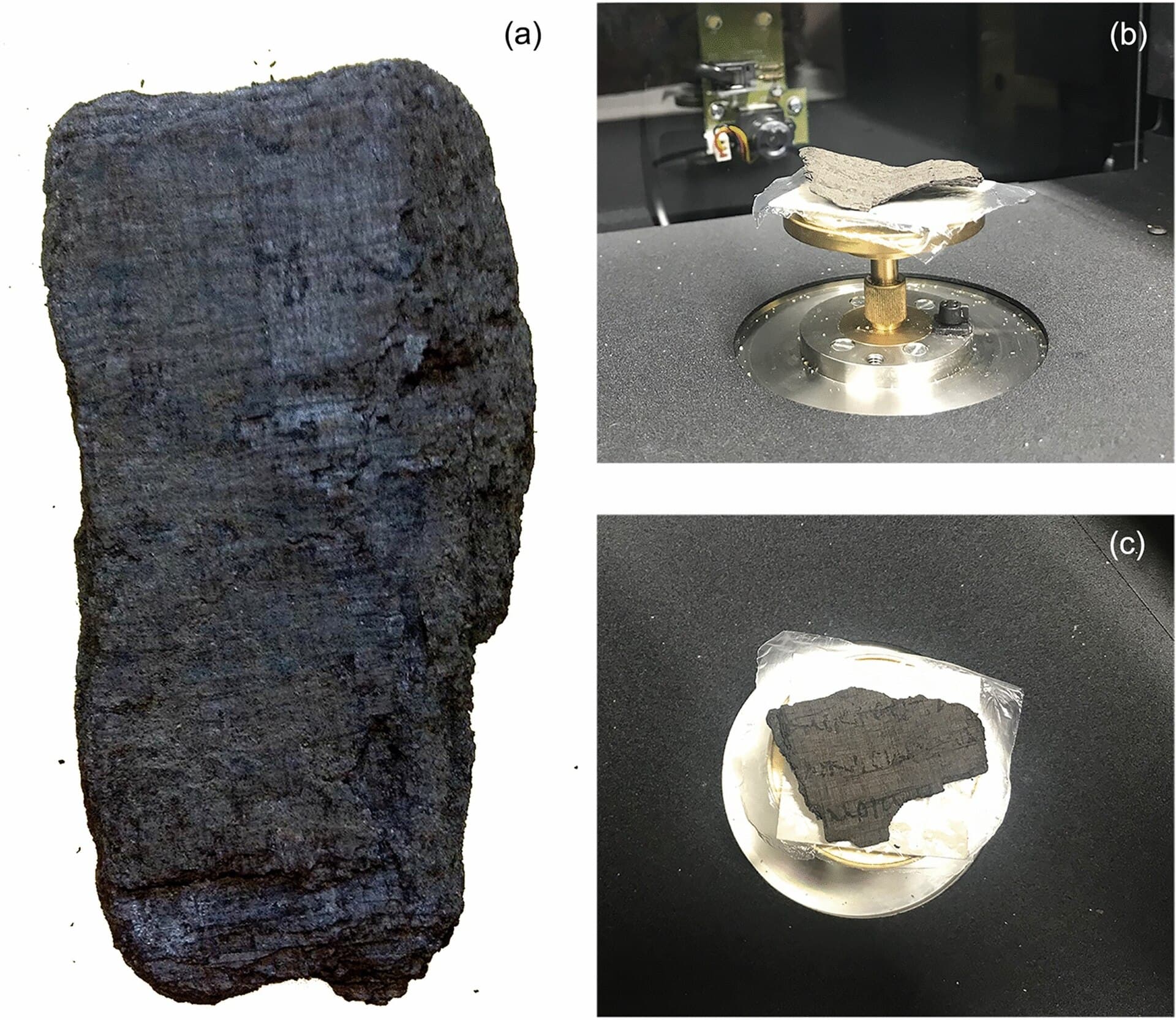
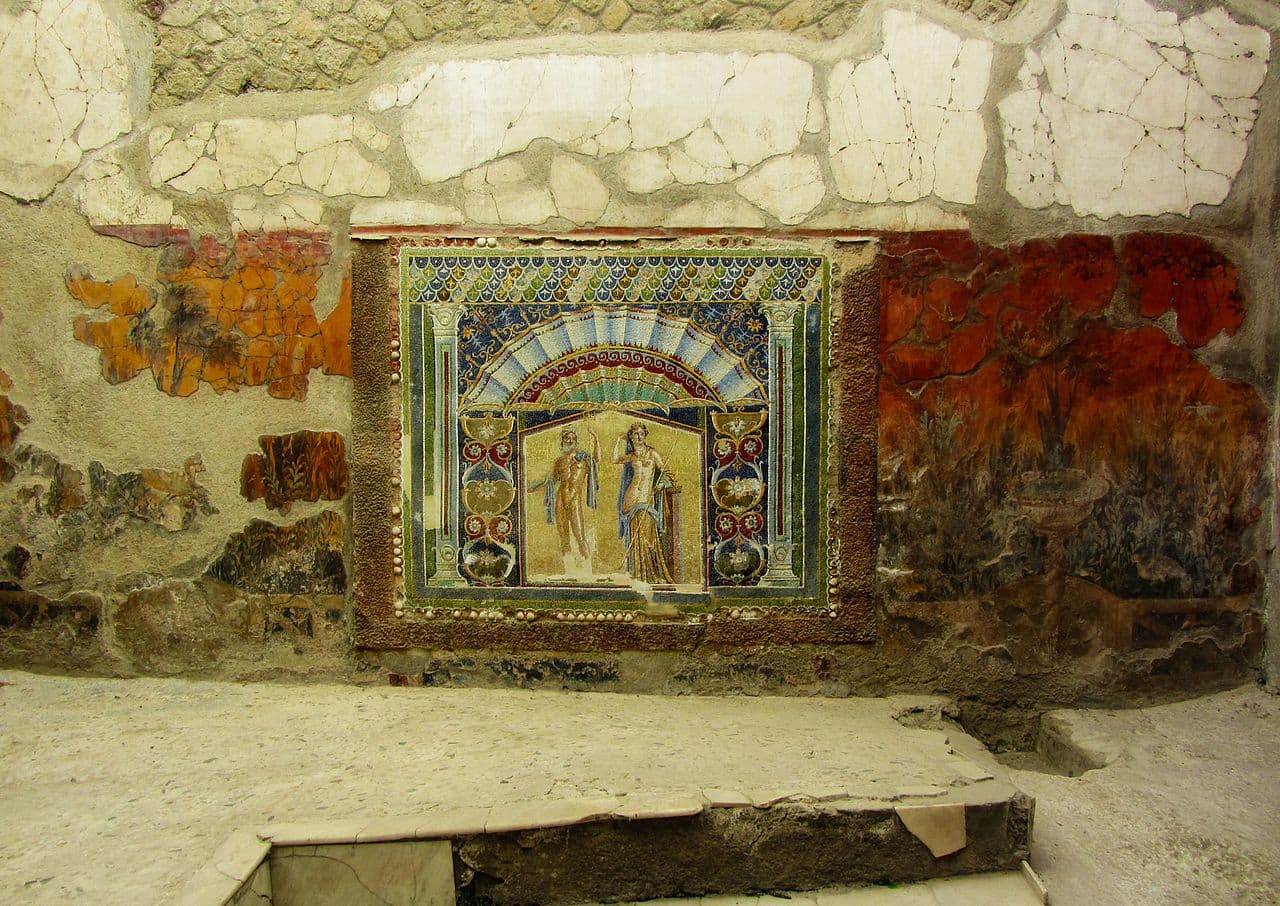
On what was traditionally thought to be the afternoon of 24 August, 79 CE, the world of ancient Rome witnessed one of its most catastrophic natural disasters. Mount Vesuvius erupted with a ferocity that would forever change the landscape of Campania. While Pompeii and other nearby towns like Oplontis and Stabiae were buried under a thick blanket of volcanic ash, it was Herculaneum that faced the devastating fury of pyroclastic surges. These superheated clouds, with temperatures soaring to 500°C, swept through the town at terrifying speeds. Among the casualties was a villa on the coast, later identified as the Villa of the Papyri. This villa, possibly belonging to Lucius Calpurnius Piso Caesoninus, housed a treasure far more valuable than its opulent design—an extensive library of papyrus scrolls. The scrolls were carbonised in the intense heat, preserving them in an almost stony state beneath 25 metres of volcanic material. For centuries, they lay undisturbed, waiting to be unearthed.
The 1752 rediscovery and what followed
In 1752, the Villa of the Papyri was rediscovered quite by accident. Under the village of Resina (now Ercolano), Bourbon antiquarians unearthed the buried villa through a series of tunnels. Initially, the carbonised scrolls were mistaken for charcoal lumps, some even used as torches. It was not until closer inspection revealed faint writing on the edges that their true nature was realised. The task of unrolling these scrolls without destroying them was given to Antonio Piaggio, an Italian monk renowned for his mechanical aptitude. Piaggio designed an intricate machine using wood and silk threads that slowly peeled back the scroll's layers, revealing the ancient texts beneath. This delicate process allowed scholars to painstakingly copy the exposed writing, but it came at a significant cost. Each scroll opened using Piaggio's method was effectively destroyed in the process. Roughly 800 scrolls were partially opened this way, but around 800 to 1,100 remain intact, held in institutions such as the National Library of Naples and the Bodleian Library.
What the opened scrolls contain
The scrolls that have been opened reveal a treasure trove of ancient Greek philosophical thought. Predominantly, they contain works of the Epicurean school, with many texts attributed to Philodemus of Gadara, a philosopher who lived in the first century BCE. His writings, such as 'On Anger', 'On Vices', and 'On Methods of Inference', dominate the collection. Philodemus was likely the resident philosopher of the Villa, and his influence pervades the library. Also present are texts by other Epicurean thinkers like Epicurus himself, Demetrius Lacon, and Carneiscus. A few Latin texts, possibly including a lost work by Lucretius's sources, have been suggested but remain unverified. This collection is unique; it is the only complete ancient library preserved from classical antiquity. While other famed libraries like those of Alexandria or Pergamum are lost to history, known only through references, the Herculaneum library exists in physical form. What secrets lie in the unopened scrolls remains a tantalising mystery. Could they hold lost works of Aristotle, ancient Greek tragedies, or more Epicurean musings? Until they could be read, speculation was all scholars had.
The 20th-century attempts
With the abandonment of Piaggio's destructive method in the mid-19th century, the remaining scrolls awaited a less damaging means of exploration. Various 20th-century attempts to unlock their secrets ended in disappointment. X-ray imaging failed, as the carbon ink used in the texts was indistinguishable from the carbonised papyrus. Chemical treatments only exacerbated the scrolls' fragility, and physical unrolling invariably led to their destruction. In 1999, Brent Seales of the University of Kentucky embarked on a promising new approach: 'virtual unrolling'. This method aimed to digitally 'flatten' the scrolls using micro-CT scanning to capture the intricate layers of rolled papyrus and then computationally trace these layers to reveal the writing. The process initially faced significant hurdles; standard CT scans could not detect differences between the ink and the carbonised substrate. However, Seales's persistence paid off in 2015 when he successfully applied this technique to the En-Gedi scroll, a Hebrew biblical text from a 6th-century synagogue. This success demonstrated the potential for his method, but the Herculaneum scrolls remained elusive due to their even fainter ink contrast.
The Vesuvius Challenge
In March 2023, a new chapter in the saga of the Herculaneum scrolls began with the launch of the Vesuvius Challenge. Spearheaded by Nat Friedman, Daniel Gross, and Brent Seales, the competition offered substantial rewards for breakthroughs in reading the unread scrolls. Hundreds of thousands of dollars were allocated for milestone prizes, with a $700,000 grand prize for the first to extract significant text from an unopened scroll. Participants were provided with Seales's micro-CT scans of scrolls PHerc.Paris.4 and PHerc.Paris.3, along with training data from previously imaged fragments where some ink was discernible. The challenge was daunting: identify the barely detectable differences between inked and non-inked papyrus surfaces within the noisy data. The contrast was slight, and the signal barely rose above the noise floor, demanding ingenuity and perseverance from all teams involved.
The 2023 breakthroughs
October 2023 marked a historic moment when Luke Farritor, a 21-year-old computer science student from the University of Nebraska, made a significant breakthrough by identifying the Greek word 'πορφύρας' (porphyras, meaning 'purple') in a previously unread fragment of PHerc.Paris.4. This achievement won him the First Letters Prize, underscoring the potential of neural networks in solving ancient puzzles. Shortly after, Youssef Nader, an Egyptian PhD student based in Berlin, independently discovered the same word using a different machine-learning strategy. In February 2024, the grand prize was awarded to a collaborative effort by Farritor, Nader, and Julian Schilliger, who successfully read 15 columns of Greek text from PHerc.Paris.4. The text is part of an Epicurean treatise, likely by Philodemus, discussing pleasure, music, and wine. It includes a critique of those who argue that scarce items are more pleasurable than common ones, reflecting Epicurean philosophy. This substantial recovery marks the first sustained passage from an unopened Herculaneum scroll.
What is happening now
As of 2026, the Vesuvius Challenge is ongoing. New imaging efforts have been undertaken at the Diamond Light Source synchrotron in Oxfordshire, producing high-resolution scans that generate massive amounts of data, potentially terabytes per scroll. The current focus has shifted to segmentation—tracing the surface of papyrus layers through the complex data as they are crumpled and fused together. Improved segmentation techniques are gradually unlocking more extensive readings. The international team, comprising researchers from Europe, the United States, and Egypt, continues to advance in their mission. The Brent Seales lab has successfully identified about 95 percent of the text on three scrolls in their initial readings. The task now is to confirm and translate these texts and ascertain their place in the broader tapestry of the classical literary record. The unopened scrolls are estimated to contain approximately 16,000 columns of text, which could significantly enhance our understanding of ancient Greek literature, given that the entire surviving corpus is roughly equivalent to about 800 books.
Most great archaeological discoveries, like Tutankhamun's tomb or the Rosetta Stone, are the result of excavation. The Herculaneum scrolls, however, have been physically present since their unearthing in 1752, yet their secrets have been locked away, awaiting the right key to unlock them. This key turned out to be not a breakthrough in chemistry or physics, but a computational one—a young computer scientist working on neural networks with a borrowed GPU. The work by Brent Seales, Luke Farritor, and Youssef Nader is not about finding what was lost, but about revealing what was hidden in plain sight for nearly three centuries. These texts have been within reach, stored in archives and libraries, since the 18th century. This is a story of patience and persistence, where the solution was not a single invention but a cumulative effort built over decades. Antiquity's whisper is finally being heard, not because it was lost, but because we have finally learned how to listen.
References
- Seales, W. B., et al. (2016). From damage to discovery via virtual unwrapping: Reading the scroll from En-Gedi. Science Advances, 2(9), e1601247.
- Vesuvius Challenge. (2024). Grand Prize Announcement: First Passages of Continuous Text from a Sealed Herculaneum Scroll.
- Janko, R. (2002). Philodemus on Poems: Book One. Oxford University Press.
- Sider, D. (2005). The Library of the Villa dei Papiri at Herculaneum. J. Paul Getty Museum.


