
In 336 BCE, Corinth was a city on the cusp of history. Alexander the Great, a mere twenty years of age, had recently assumed the mantle of king of Macedonia and hegemon of the League of Corinth. His reputation was rapidly growing as a formidable leader with ambitions that extended far beyond the Greek city-states. In this climate of burgeoning power and prestige, Alexander sought to pay homage to the famous, if unconventional, philosopher Diogenes of Sinope. Diogenes, then sixty-eight, had been residing in Corinth for over a decade, living in stark contrast to the opulence and ambition of the young king. The encounter between these two disparate figures, recorded much later by Diogenes Laertius, paints a vivid picture of the philosopher’s disdain for material and social trappings. When Alexander greeted Diogenes and offered to grant him any favour, the philosopher simply asked him to step out of his sunlight. Amused rather than offended, Alexander reportedly quipped to his entourage, 'If I were not Alexander, I would wish to be Diogenes.' Whether this exchange happened exactly as described remains uncertain, but its essence—Diogenes's irreverent indifference to power—captures the radical nature of his philosophy.
Who he was before the philosophy
Diogenes was born around 412 BCE in the Greek colony of Sinope, which is now modern-day Sinop, Turkey. His father, Hicesias, was a moneyer, an official responsible for minting and certifying the city's coinage—a position of significant local influence. However, the family’s fortune took a dramatic downturn in the 380s BCE when Diogenes and his father became embroiled in a scandal involving the defacement of currency. The exact nature of their crime is lost to history; accounts vary from allegations of corruption to adulterating the silver content of the coins. The consequences were severe: Hicesias was imprisoned and eventually died behind bars, while Diogenes was exiled, severing his ties to his birthplace and its social standing.
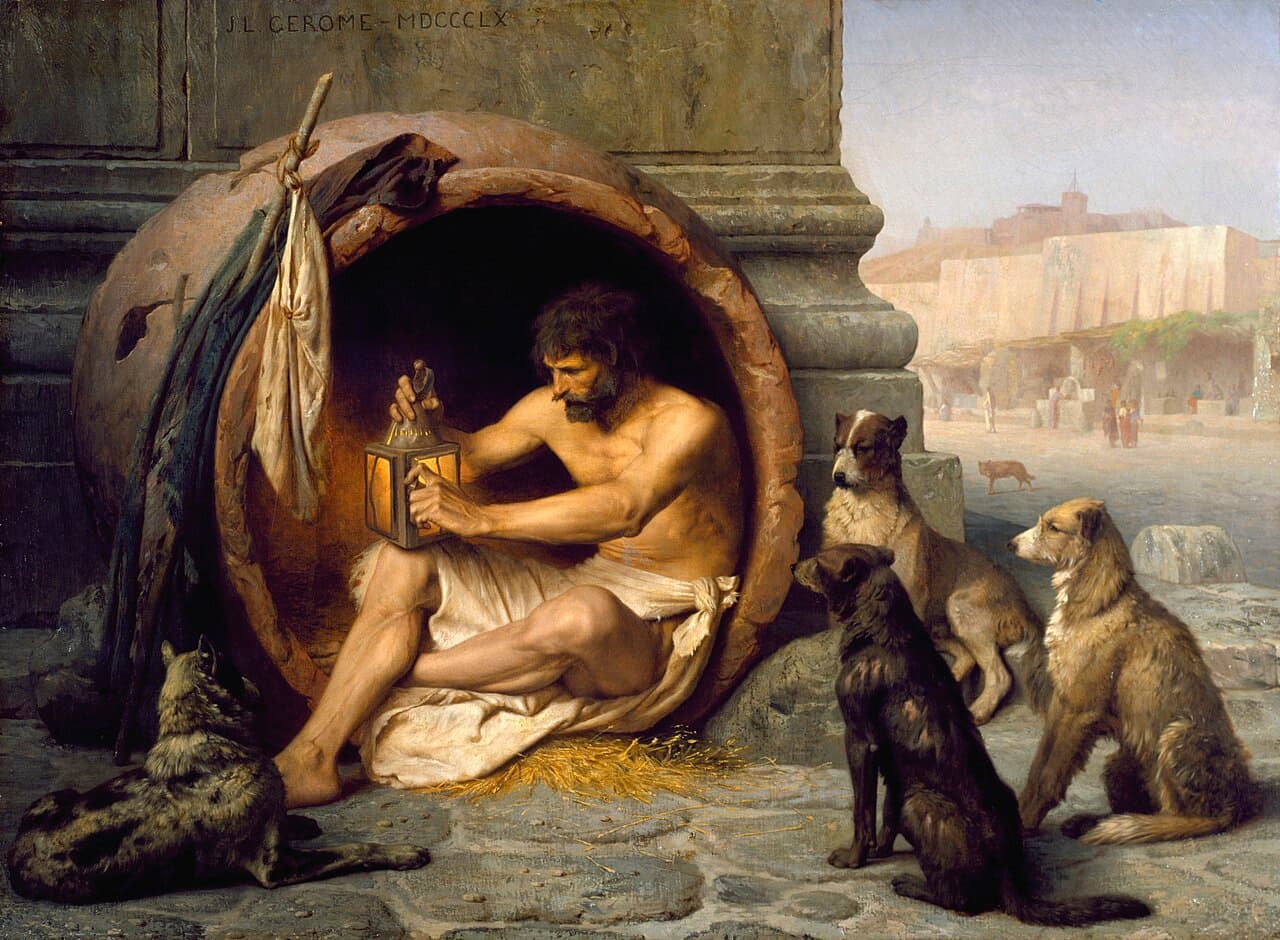
Following his exile, Diogenes arrived in Athens with nothing to his name. The intervening years between his arrival and his emergence as a philosophical figure are largely undocumented, but by the late 350s BCE, Diogenes was recognised as a leading, albeit extreme, exponent of Cynicism. This philosophical school, founded by Antisthenes—a former pupil of Socrates—emphasised self-sufficiency and a rejection of societal conventions. Diogenes took these principles further than any before him. He lived in a large clay storage jar, called a pithos, often mistranslated as a 'barrel.' His possessions were minimal: a staff, a cloak, and a wallet for scraps. He had no permanent home, no family, and no property. His way of life was his manifesto, a radical embodiment of Cynic ideals.
What the philosophy was
Diogenes's practice of Cynicism distilled the philosophy into three central tenets. Firstly, he posited that virtue is the sole good. Material wealth, social standing, power, and comfort—things that people typically strive for—are not goods but distractions that corrupt virtue. Secondly, he asserted that societal conventions are merely 'second nature'—deeply ingrained habits and customs that people mistakenly regard as essential. The task of the Cynic is to identify and discard these false necessities. Thirdly, Diogenes argued that the good life is defined by autarkeia, or self-sufficiency: a contentment with what nature truly requires. He demonstrated this principle through his own life, reducing his needs to the barest minimum.
This radical reduction was not merely asceticism for its own sake but a philosophical exercise. Diogenes famously defecated, urinated, ate, slept, and even masturbated in public, not from shamelessness but as a logical extension of his belief that nothing natural is shameful. Such acts horrified his contemporaries but underscored his philosophical point. Later, the Stoics, emerging under Zeno of Citium—who studied under Crates, a disciple of Diogenes—would inherit a tempered form of these ideas. The Stoic doctrine of living in accordance with nature bears the imprint of Cynic ethics, albeit without its rough edges. Diogenes's lifestyle was not an end but a means to critique society and advocate for a return to a simpler, more honest way of living.
The performances
Diogenes's method of teaching was unconventional, often taking the form of public performance—what modern scholars sometimes refer to as 'philosophical performance.' His acts were deliberate provocations aimed at exposing the hypocrisies of Athenian society. One of his most famous performances involved carrying a lit lantern in broad daylight, claiming to be 'searching for an honest man.' This act was a direct critique of the integrity he perceived as lacking in his fellow citizens.
Another notable incident occurred during a lecture by Plato. When Plato defined a human as 'a featherless biped,' Diogenes plucked a chicken and presented it to Plato, declaring, 'Here is Plato's man!' This led to Plato amending his definition to include 'with broad flat nails.' Diogenes's antics, though humorous, consistently aimed to point out the gap between what people professed to believe and what they actually practiced. His life was an ongoing spectacle of philosophical satire that Athens could not ignore. Diogenes Laertius, in his 'Lives of Eminent Philosophers, Book VI,' records hundreds of such anecdotes. While many may have been embellished over time, the core message remains: Diogenes communicated his philosophy through lived example, making the abstract concrete through public acts.
The wider Cynic movement
Diogenes was not the founder of Cynicism—that distinction belongs to Antisthenes—but he became its most radical and visible exponent. The Cynic tradition included a number of significant figures who contributed to its development. Crates of Thebes, Diogenes's most renowned student, voluntarily renounced his wealth to embrace the Cynic lifestyle. Crates and his wife, Hipparchia of Maroneia, were notable for being the first recorded married couple in Greek philosophy. Hipparchia, rejecting wealthy suitors, joined the Cynic movement and reportedly debated publicly with philosophers such as Theodorus the Atheist, asserting her intellectual autonomy and contributing to the movement’s discourse.
Menippus of Gadara, a former slave, expanded the movement's reach through literature, developing the Menippean satire—a genre blending prose and verse that satirised human pretensions. Bion of Borysthenes, another key figure, was a popular philosopher whose works influenced both the Stoic tradition and the rhetorical culture of later centuries. By the third century BCE, Cynicism had emerged as a recognised philosophical school across the Hellenistic world, influencing not only Stoicism but also early Christian asceticism and later philosophical traditions. The Cynic ethos of voluntary poverty, public provocation, and principled nonconformity can be seen as precursors to various movements and figures who chose to live on society's margins to question and critique its values.
What we cannot know
The full scope of Diogenes's philosophy is partially obscured by history's veil. None of his writings survive, though he is said to have penned dialogues and treatises with titles like 'Republic' and 'On Death,' suggesting a direct engagement with Platonic themes. Our primary biographical source, Diogenes Laertius's 'Lives of Eminent Philosophers,' written approximately six centuries after Diogenes's lifetime, offers a rich but cautionary tapestry of anecdotes. These stories, drawn from earlier, now-lost sources such as those by Hermippus of Smyrna and Antisthenes of Rhodes, are filtered through a long chain of transmission.
The anecdotes are a mix of the philosophical, the comedic, and the legendary. Modern classical scholars such as Marie-Odile Goulet-Cazé and Pierre Hadot have sifted through these accounts, delineating between what might be historical fact and what is likely literary embellishment. The conservative view holds that Diogenes lived as the tradition describes: a nonconformist who founded no formal school and taught through his way of life, leaving a legacy of stories that blend fact with allegory. The veracity of specific tales may be uncertain, but the philosophical method—living as an example—remains clear.
Why the figure persists
Diogenes endures in cultural memory for two primary reasons. First, the philosophical critique he embodied remains compelling. The Cynic challenge—that societal norms are constructions that can be discarded, that virtue is independent of material conditions, and that authority can be questioned through direct action—continues to resonate. These ideas find echoes in modern minimalist movements, various forms of voluntary poverty, and philosophical anarchism. They also intersect with contemporary environmental and social critiques, challenging the assumed necessities of modern life.
Second, Diogenes as a figure is irreducible to mere doctrine. Unlike most philosophers, whose ideas can be distilled into summaries, Diogenes's philosophy was inseparable from his life. He embodies the philosophy he taught, making it tangible and memorable through vivid, often shocking scenes. The cultural archetype of the wise fool—immune to societal pressures and unawed by power—has been perpetuated through figures such as Saint Francis of Assisi, certain Sufi poets, and Russian holy fools (yurodivye). The internet's modern memes of Diogenes illustrate that his irreverence and insight continue to captivate, reinforcing his place in the public imagination not as a static idea but as a perpetual challenge to convention.
Diogenes died in Corinth around 323 BCE, having lived a full life by any measure, despite—or because of—his unconventional choices. The exact cause of his death is shrouded in uncertainty, with stories ranging from self-imposed suffocation to a meal of raw octopus gone wrong. His friends in Corinth wished to honour him with a proper burial, but Diogenes had reportedly requested his body be left unburied to be consumed by animals, in keeping with his philosophy of natural simplicity. They compromised, placing a stone marker adorned with the image of a dog—a nod to the Greek word 'kunikoi,' or 'dog-like,' from which 'Cynic' is derived. While his tomb has been lost to time, the impact of his life endures. The anecdotal legacy, the Cynic tradition, and his indirect influence on Stoicism and beyond keep his light alive. The man who once asked Alexander to step aside remains a beacon of philosophical irreverence.
References
- Diogenes Laertius. Lives of Eminent Philosophers, Book VI. Translated by R. D. Hicks, Loeb Classical Library, 1925.
- Desmond, W. (2008). Cynics. Acumen Publishing.
- Goulet-Cazé, M.-O., & Branham, R. B., eds. (1996). The Cynics: The Cynic Movement in Antiquity and Its Legacy. University of California Press.
- Navia, L. E. (1996). Classical Cynicism: A Critical Study. Greenwood Press.


