
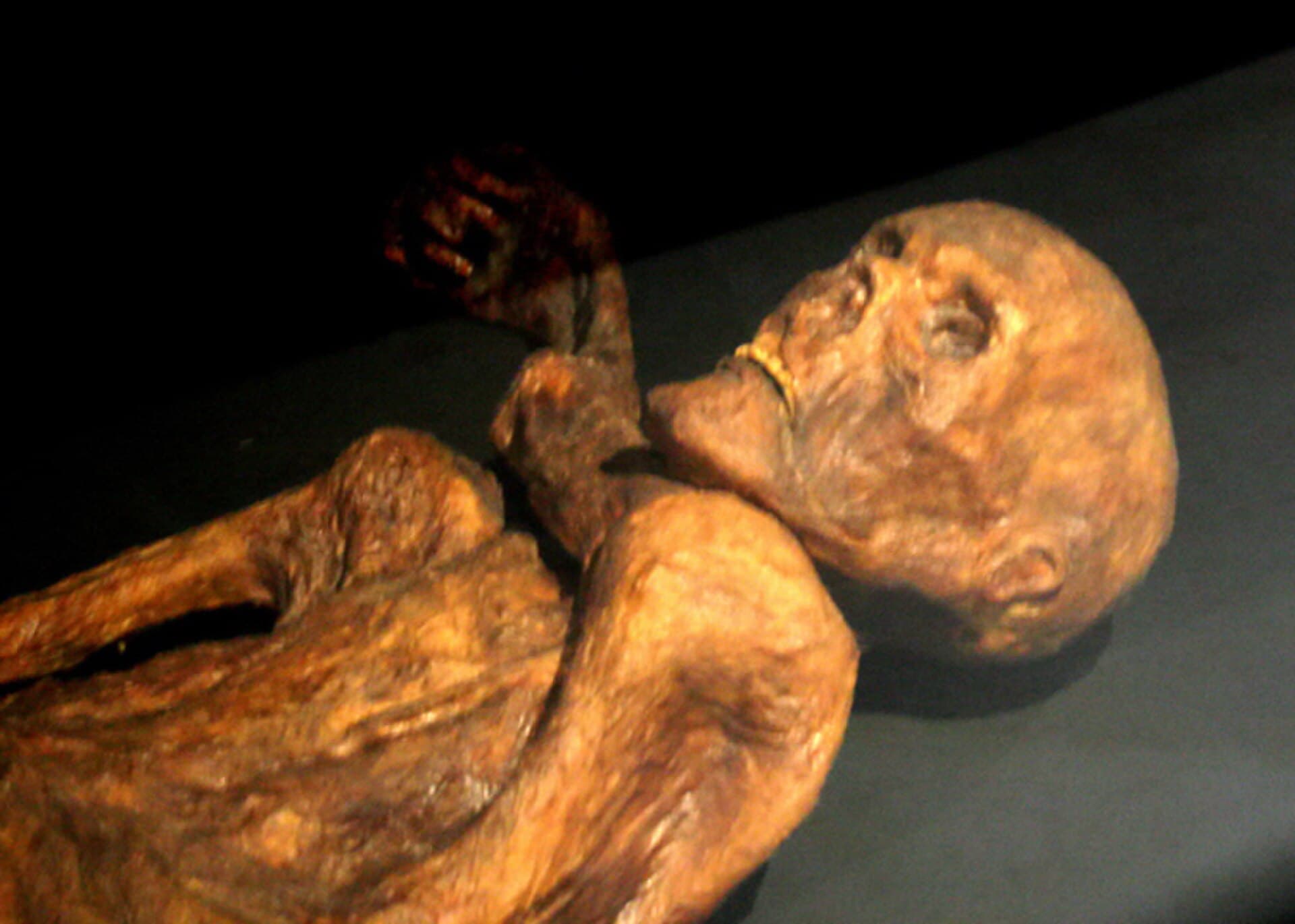
On 19 September 1991, Erika and Helmut Simon, German hikers from Nuremberg, made a discovery that would capture the attention of the archaeological world. As they descended off-trail toward a small gully at the Tisenjoch pass, 3,210 metres up in the Ötztal Alps on the Austrian-Italian border, they stumbled upon what initially seemed like discarded equipment. Closer inspection, however, revealed a brown human form protruding from the ice. This was no ordinary mountaineer in distress; they had found Ötzi, a man born around 3370 BCE who died approximately 5,300 years ago. For the past five millennia, his body had been preserved in ice, hidden from the world until the receding glacier revealed his resting place.
What was on him and around him
The inventory recovered from the site between 1991 and 1992 paints a vivid picture of Ötzi's final moments. Among his possessions was a yew longbow, only partly finished, suggesting that he may have been in the process of making or repairing it. His quiver contained 14 arrows, yet only two were completed and fletched, indicating preparation for future hunts rather than immediate readiness. The copper axe found with him, with its metallurgical analysis showing it to be 99.7% copper, was particularly striking. This axe, smelted from southern Tuscan ore, highlights the extensive trade networks of the time.
Ötzi also carried a flint dagger with an ash handle, a tool of significant utility in his environment. His backpack frame was made of larch wood, sturdy yet lightweight. Birch-bark containers were among his belongings, likely used for carrying food or other essentials. A retoucheur, an antler-tipped tool for sharpening flint, was part of his toolkit. Additionally, two pieces of dried birch fungus were found, probably used as tinder, crucial for survival in the harsh Alpine climate. His clothing, including a goat-skin coat, a bearskin cap, a grass cloak, leather leggings, and hay-stuffed shoes with bearskin soles, suggests a resourceful adaptation to the environment.
What he ate
Earlier assumptions that Ötzi died of starvation were overturned by a 2009 re-examination of his stomach contents. His stomach was found to be full, indicating he had eaten shortly before his death. This last meal consisted of ibex meat, red deer meat, einkorn wheat bread, and bracken fern, providing a rich mix of proteins and carbohydrates. The timing was reconstructed with remarkable precision: he ate within 30 to 120 minutes before his demise.
Ötzi also carried additional provisions. In a birch container, smoked ibex meat was found, evidence of both his foresight and the available preservation techniques of his time. Analysis of his digestive tract revealed bowel parasites, specifically whipworm, an indication of the less than sanitary conditions he might have endured. Furthermore, pollen of a hop hornbeam, which flowers only in spring at lower altitudes, was present in his colon, offering clues to his movements before reaching the high-altitude pass.
His body
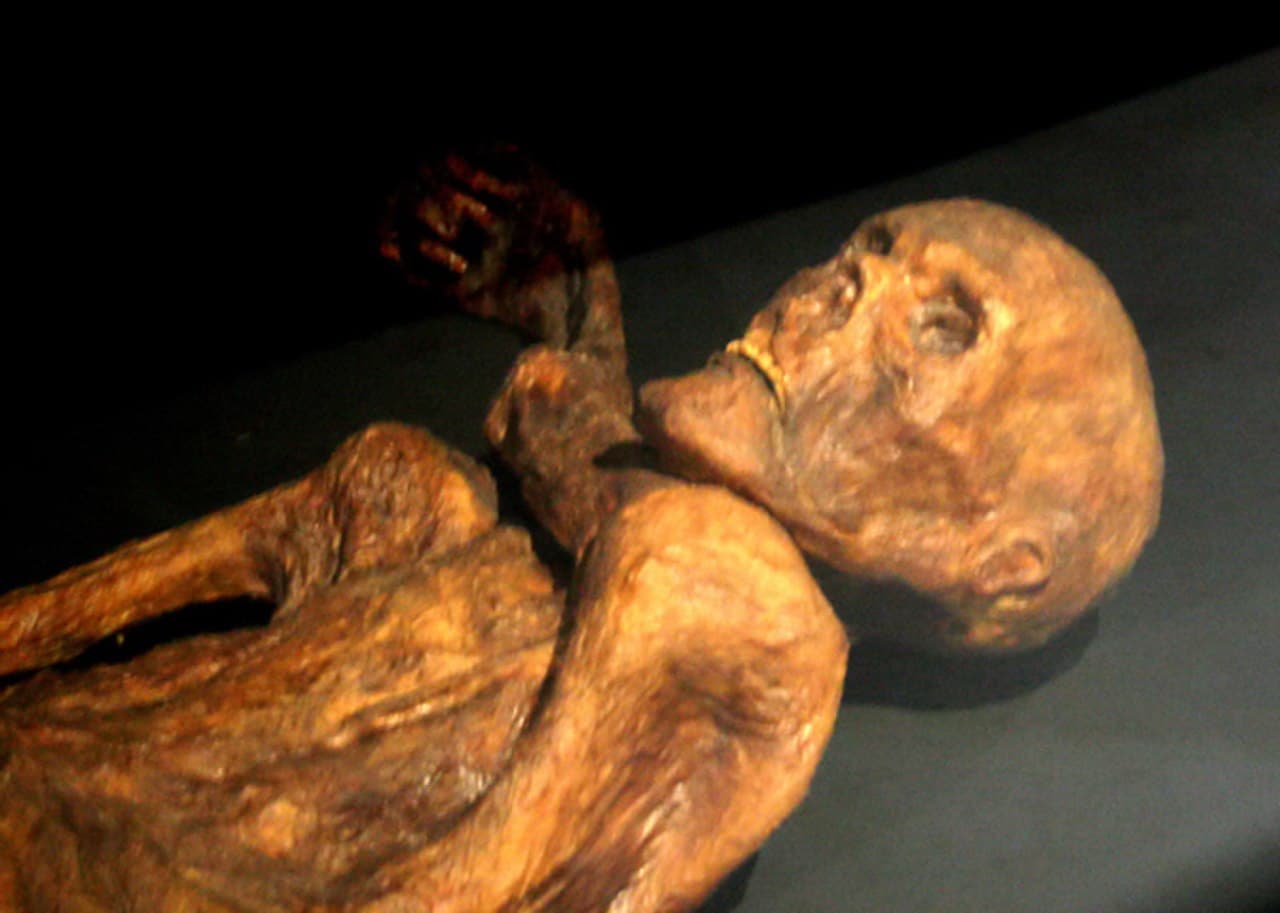
Standing at approximately 1.60 metres tall and weighing around 50 kilograms, Ötzi was about 45 years old when he died. Genetic studies, including those by Keller et al. (2012), have shown that he was of southern European descent. His Y-chromosome haplogroup, G2a, is now rare in modern Europe but can still be found in regions such as Sardinia and Corsica. His body bears 61 tattoos, consisting of short black lines and crosses, applied by rubbing soot into small incisions. These tattoos are predominantly located on his lower back, knees, and ankles, corresponding to modern acupuncture points used for treating osteoarthritis.
X-rays of his joints reveal degenerative changes consistent with osteoarthritis, lending credence to the idea that these tattoos were therapeutic rather than purely decorative. His preserved body, with all its marks and modifications, provides a unique insight into the medical practices of the Copper Age. Such findings continue to captivate researchers, offering a direct link to the health and lifestyle of an ancient individual.
How he died
The cause of Ötzi's death has been the subject of much investigation. In 2001, X-rays conducted by Paul Gostner revealed a stone arrowhead lodged in his left shoulder, behind the collar bone. The shaft had been removed, but the arrowhead remained, indicating a violent encounter. Further examination uncovered a deep cut on his right hand and bruising on the back of his skull.
Albert Zink, along with his colleagues at the EURAC Institute for Mummy Studies in Bolzano, has contributed significantly to understanding Ötzi's demise. The current consensus is that Ötzi was attacked in the valley below and, despite his injuries, managed to escape and climb to the pass. It is believed he succumbed there, where his assailant caught up with him. The arrow wound in his shoulder was fatal, severing the subclavian artery, leading to rapid blood loss and death within minutes.
Why he survived as a body
Ötzi's preservation can be attributed to the unique conditions of the glacier where he died. Glacier ice is biologically inert, lacking the microbial activity that would lead to decomposition. He perished in a small gully, which quickly filled with snow and ice, effectively entombing him. The ice around this rock-protected hollow did not scour or thaw for 53 centuries, ensuring Ötzi's survival as a wet mummy.
He remains one of only a handful of Copper Age wet mummies known worldwide, a category distinct from the dry mummies of Egypt and other arid regions. The exceptional preservation allows scientists to study his remains in unprecedented detail, providing insights that dry bones alone cannot offer. Such a find reshapes our understanding of the conditions necessary for preserving organic matter across millennia.
What he tells us about the Copper Age
Before Ötzi's discovery, our understanding of Copper Age Europe—roughly 3500 to 2500 BCE—was predominantly reconstructed from settlements and grave sites. Ötzi, however, offers a tangible connection to this distant past, putting a face to the era. His clothing, tools, and even his diet provide personal details that enrich our archaeological narrative. The copper axe, originating from southern ore yet found high in the Alps, is evidence of the long-distance trade networks that existed during his lifetime.
Additionally, his parasite load and joint disease introduce a dimension of everyday suffering that is often absent from archaeological records focused on artefacts and grave goods. The discovery of Ötzi has therefore been pivotal in redefining our understanding of the Copper Age, bringing into focus the lived experiences of individuals from this period rather than just the material culture they left behind.
Currently, Ötzi rests in a custom-built refrigerated chamber at the South Tyrol Museum of Archaeology in Bolzano. Maintained at -6 °C and 98% humidity, he is visible to visitors through a small window, a testament to the ongoing fascination with his story. The research programme initiated by his discovery has been prolific, resulting in over 200 peer-reviewed papers since 1991.
Remarkably, we probably know more about Ötzi's last meals than we do about any other person who lived more than three thousand years ago. This level of detail illustrates not only the capabilities of modern science but also the serendipitous nature of archaeological discovery, where chance and technology intersect to bring the distant past into sharp relief.
References
- Zink, A., & Maixner, F. (2019). The current situation of the Tyrolean Iceman. Gerontology, 65(6), 699–706.
- Maixner, F., et al. (2018). The Iceman's last meal consisted of fat, wild meat, and cereals. Current Biology, 28(14), 2348–2355.
- Keller, A., et al. (2012). New insights into the Tyrolean Iceman's origin and phenotype as inferred by whole-genome sequencing. Nature Communications, 3, 698.
- South Tyrol Museum of Archaeology, Bolzano. Ötzi the Iceman.


