

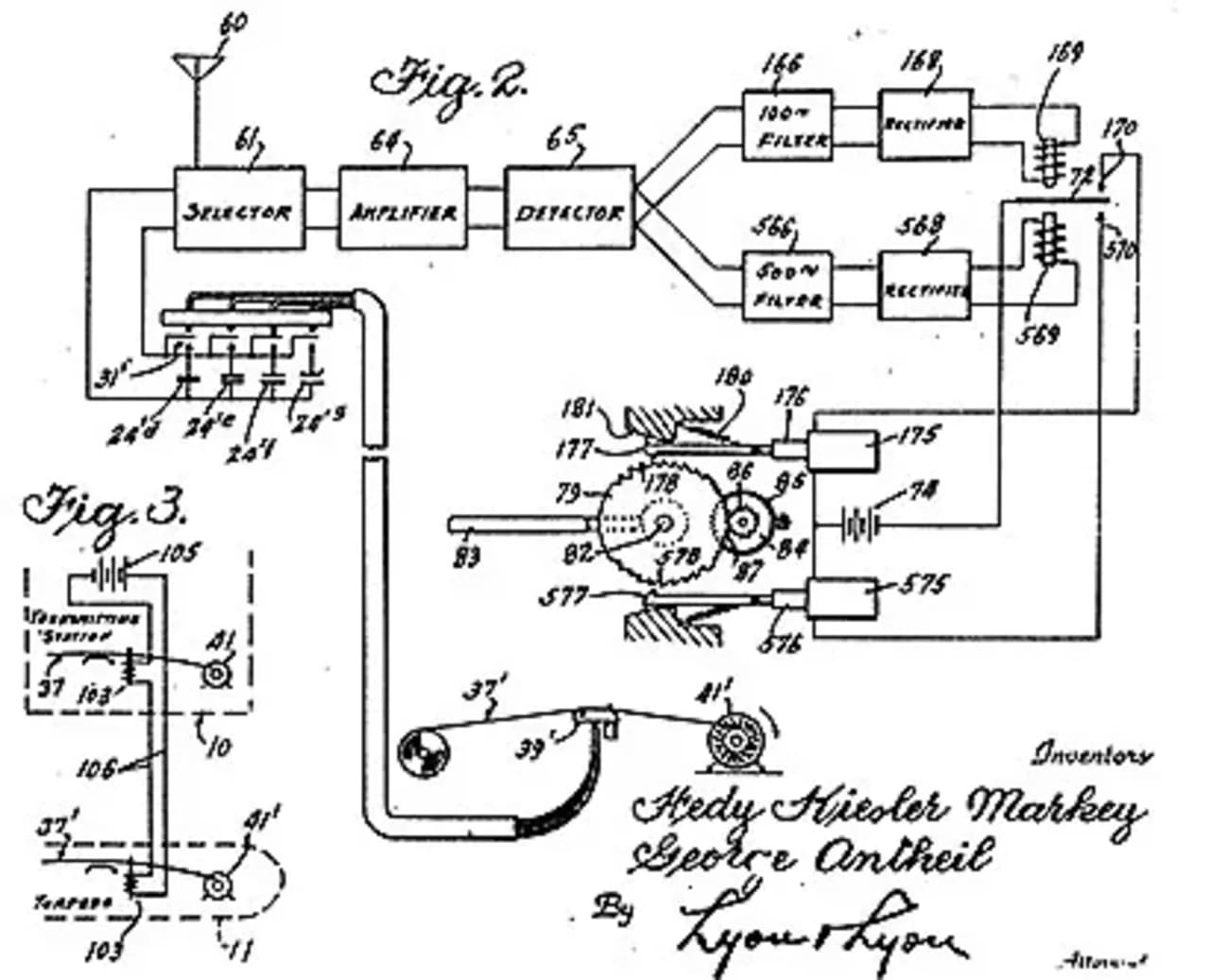
In the annals of technological history, few patents hold the peculiar origin story of US Patent 2,292,387. Filed on 10 June 1941 and granted on 11 August 1942, it bore the title 'Secret Communication System'. Its inventors of record were Hedy Kiesler Markey and George Antheil. Markey, born in Vienna as Hedwig Kiesler, was better known to the world as Hedy Lamarr, the glamorous Hollywood actress of the silver screen. Antheil, her collaborator, was a modernist composer with a penchant for the avant-garde, having worked alongside luminaries like Ezra Pound and Igor Stravinsky in the vibrant artistic milieu of 1920s Paris. The patent they produced was no ordinary one—it detailed a method of frequency-hopping spread spectrum, a principle that would become foundational to the wireless communication technologies that underpin our interconnected world today.

Who Lamarr was
Hedy Lamarr, born as Hedwig Eva Maria Kiesler in Vienna in 1914, came from a well-to-do assimilated Jewish family. Her journey to fame and invention was as dramatic as any of her film roles. At the tender age of 18, she married Friedrich Mandl, a wealthy Austrian arms manufacturer, whose trade connections spanned Europe, including dealings with Fascist Italy. This marriage, however, would become more a gilded cage than a romantic union, as Mandl's controlling nature and collaboration with regimes that Lamarr found objectionable led to a deep personal and ideological rift. By 1937, she had divorced Mandl and escaped to London, a decision fueled by the rising threat of fascism and her own ambitions for freedom and creativity. In London, she caught the attention of Louis B. Mayer, the Hollywood mogul, who quickly recognized her potential star power and offered her a contract. Thus, the Austrian ingenue became Hedy Lamarr, the actress, embarking on a career in Hollywood where she would enjoy a substantial but not legendary career throughout the 1940s. Despite her talents and a string of successful films, including 'Algiers' and 'Samson and Delilah', Lamarr's intellectual curiosities were never far from the surface, quietly bubbling beneath her glamorous public persona.
Who Antheil was
George Antheil, born in Trenton, New Jersey, in 1900, was a man whose life story reads like a composition of its own. A fervent modernist composer, Antheil was best known for 'Ballet Mécanique', a 1924 piece that featured an ensemble as unusual as it was ambitious, including synchronised player pianos, airplane propellers, and electric bells. This audacious work mirrored the chaotic energy of the modern era and cemented his place within the avant-garde movements of the time. After his European ventures, Antheil settled into the world of Hollywood scores during the 1930s, a period marked by versatility and adaptation to more commercial forms. Yet, his intellectual pursuits extended well beyond music. Antheil wrote prolifically on topics as varied as hormone endocrinology and military strategy, contributing articles to popular magazines and showcasing his eclectic interests. It was at a party in Hollywood in 1940 that Antheil met Lamarr, a meeting that would set the stage for their collaborative venture into the realm of technology and patents.
The problem they were trying to solve

During the early 1940s, the threat of radio-guided torpedoes was a significant concern for the Allied forces. These torpedoes, while technologically advanced, were vulnerable to being jammed by enemy forces, who could broadcast interference on the same frequency to disrupt their signals. Hedy Lamarr, with her background knowledge gleaned from Mandl's conversations with arms manufacturers, saw a potential solution. She envisioned a system where both the signal transmitter and the receiver could jump between different frequencies in a prearranged sequence, thwarting the jammer's attempts to block the communication. George Antheil's experience with synchronised player pianos proved to be the perfect complement to Lamarr's idea. Together, they devised a method of synchronisation using paper-tape mechanisms similar to those found in player pianos. Their patent detailed the use of 88 frequencies—one for each key of the piano—allowing the communication to hop in harmony, making it almost impossible for a jammer to keep pace.
Why the Navy didn't use it
Despite its ingenuity, the Navy was not immediately taken by the Lamarr-Antheil invention. The official reasoning hinged on the practicality, or rather the impracticality, of implementing the paper-tape synchronisation in a torpedo system, which was deemed too cumbersome and delicate for wartime use. Yet, there were likely other underlying reasons for the Navy's hesitance. The inventors, neither of whom had formal military or engineering credentials, might have faced skepticism from a military establishment unaccustomed to sourcing innovation from Hollywood and the arts. Additionally, the wartime context suggested that Lamarr's celebrity status could be better leveraged in the propaganda effort, a theory supported by her successful involvement in selling war bonds, raising an astonishing $25 million in one night according to some accounts. As a result, the patent languished in obscurity, expiring without any immediate commercial or military application by 1959.
What came of it later
The principle of frequency-hopping spread spectrum, though shelved initially, did not fade into obsolescence. By the late 1950s, independent developments in military communications began to echo the ideas within the Lamarr-Antheil patent. In 1962, the Sylvania Electronic Systems Division constructed systems for the US Navy that bore striking resemblance to the earlier concept of synchronised frequency hopping. Despite the fact that the patent had expired, it was eventually recognised as prior art, a nod to the original inventors' foresight. In the civilian sector, spread-spectrum techniques began to gain traction throughout the 1970s and 1980s, finding a place within an array of telecommunications technologies. Today, frequency-hopping spread spectrum is foundational to Bluetooth technology, which astonishingly hops 1,600 times per second across 79 channels. It is also embedded in CDMA cellular networks, certain Wi-Fi modes, and the signals transmitted by GPS satellites. The inventors' core idea, though once overlooked, has become an essential component of modern wireless communication.
What Lamarr got, and didn't
Hedy Lamarr's contributions to technology went largely unrecognised during her lifetime, and she received no financial compensation for the patent she and Antheil had crafted. As was common with wartime inventions, the patent had been assigned to the National Inventors Council, effectively placing it in the service of national defense rather than private enterprise. It wasn't until decades later that Lamarr began to receive accolades for her groundbreaking work. In 1997, she was awarded the Electronic Frontier Foundation Pioneer Award, the first woman to earn such a distinction, acknowledging her significant impact on the field of technology. Lamarr passed away in 2000 at the age of 86, by which time her legacy as an inventor had begun to overshadow her Hollywood fame. George Antheil, who died in 1959 at the age of 58, would not live to see the recognition of their joint venture. However, in 2014, both were inducted posthumously into the National Inventors Hall of Fame, a tribute to their inventive spirit and enduring influence on technology.
Today, the concept of frequency-hopping spread spectrum is not just a historical footnote but an active component in the devices that populate our daily lives. The smartphone you might be holding uses it every time Bluetooth is engaged, hopping seamlessly among frequencies to maintain a connection. The Wi-Fi router buzzing quietly in the background, the GPS guiding you through unknown streets—all these technologies are built upon principles that Hedy Lamarr and George Antheil first envisioned. Although the exact form of their invention was not directly implemented, the core idea of synchronised frequency hopping to evade interference has found a firm foothold in modern communication systems. The delay in recognising and utilising this idea is not unique; the history of innovation is replete with examples of brilliant ideas waiting patiently for their moment in the sun. In this regard, Lamarr and Antheil's contribution serves as a poignant reminder of the unpredictable pace at which genius can be acknowledged and adopted.
References
- Markey, H. K., & Antheil, G. (1942). Secret Communication System. US Patent 2,292,387.
- Rhodes, R. (2011). Hedy's Folly: The Life and Breakthrough Inventions of Hedy Lamarr, the Most Beautiful Woman in the World. Doubleday.
- Scholtz, R. A. (1982). The origins of spread-spectrum communications. IEEE Transactions on Communications, 30(5), 822–854.
- Bluetooth Special Interest Group. Core specification (frequency hopping).


