
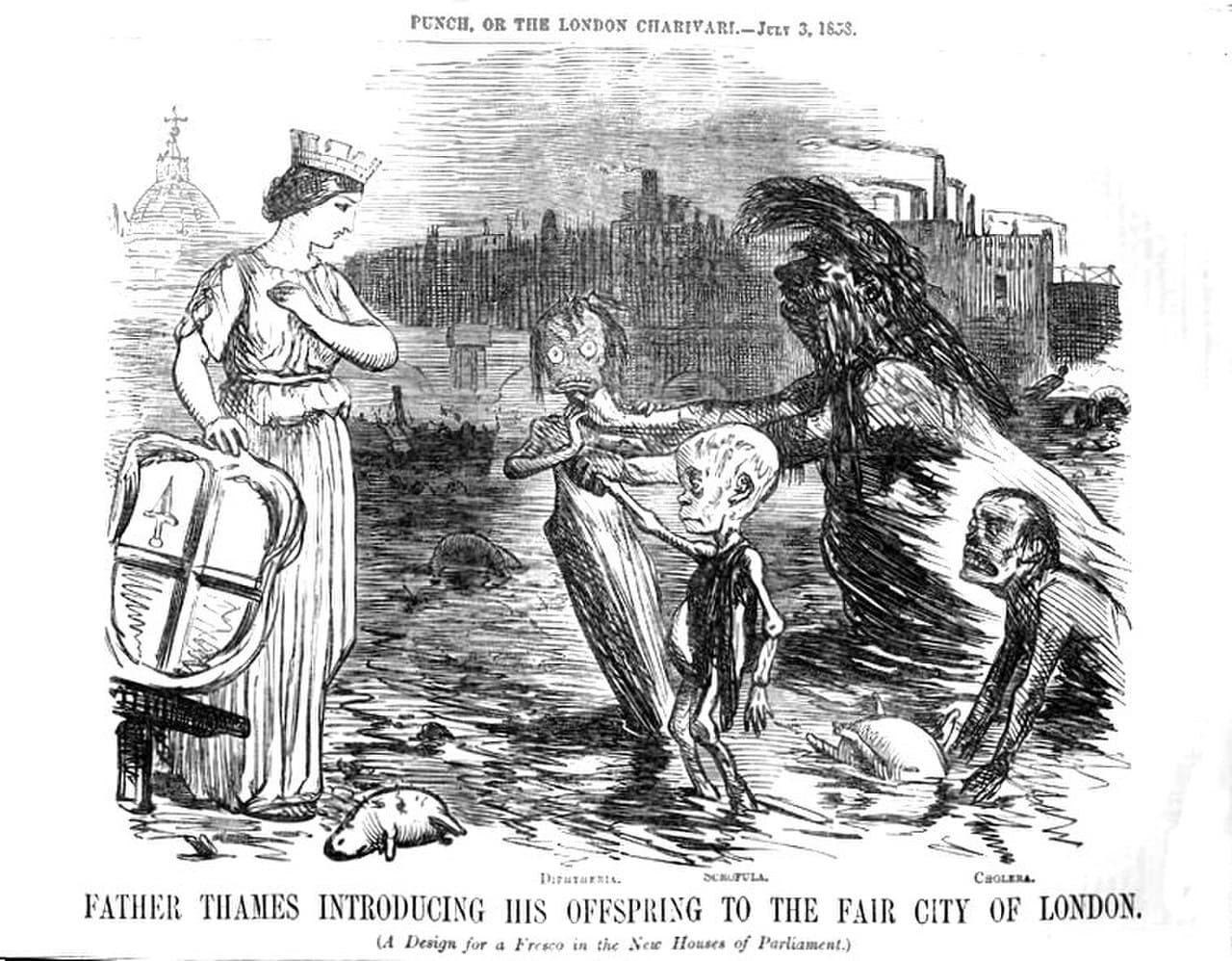
In June 1858, as the summer sun relentlessly warmed the city, the Palace of Westminster became an intolerable place to be. The Thames River, running alongside the Gothic spires of the British Parliament, was more an open sewer than a river. The transformation of London’s domestic sewage system in recent years had redirected the waste of millions from individual cesspools directly into the river. What was intended as a solution proved catastrophic: the soil that had once absorbed much of the sewage now contributed nothing to its disposal. By the time the tide reached Westminster, the Thames was composed of almost 90 per cent untreated sewage. The air reeked of decomposing waste, thick with hydrogen sulphide and other noxious gases. Members of Parliament, gasping in their committee rooms, resorted to pressing handkerchiefs soaked in chloride of lime to their noses. In a desperate move, the Lord Chief Justice contemplated relocating the courts away from the miasma. The crisis reached a peak on 18 June when Benjamin Disraeli, unable to bear the stench any longer, proposed an emergency bill to fund a comprehensive sewer system. Within less than a month, the bill had passed, setting the stage for Joseph Bazalgette, Chief Engineer of the Metropolitan Board of Works, to enact a long-awaited plan.
What had been happening
London in the 1850s was a city groaning under the weight of its own success. With a burgeoning population of over three million, the metropolis was growing at a rate that far outstripped the capacity of its sanitary infrastructure, originally designed for a much smaller population. Traditional cesspools, once sufficient for a scattered populace, became liabilities. They overflowed with alarming regularity, contaminating wells and street drains, their contents unable to seep away into the already saturated ground. Cholera, a relatively recent import from the East, had become a grim fixture of London life. The epidemics of 1848–49 and 1853–54 had claimed 14,000 and 11,000 lives respectively, and another was yet to come in 1866.
The public-health discourse of the time was dominated by the miasma theory, a concept championed by figures like Edwin Chadwick, which posited that disease was spread through "bad air"—the foul vapours arising from decomposing organic matter. This theory had held sway since the 17th century, and its influence was profound. Efforts to combat cholera focused on improving ventilation and eliminating malodours, rather than addressing the true source of contagion. Thus, the conversion from cesspools to a network of sewers was seen as a logical move, as it promised to rid households of noxious smells by channeling waste to the river, where it was thought it would be harmlessly diluted. Instead, this solution concentrated cholera pathogens in the very river from which the city drew much of its drinking water, compounding the public health crisis.
John Snow and what was already known
Amidst the general adherence to miasma theory, a lone voice of dissent had been raised by Dr. John Snow. An anaesthesiologist of some repute—having administered chloroform to Queen Victoria during the birth of her son Leopold in 1853—Snow had a different perspective on cholera. Since 1849, he had argued that the disease was waterborne, a hypothesis that challenged the prevailing orthodoxy. His pioneering investigation into the 1854 cholera outbreak in Soho provided compelling evidence for his theory. Snow meticulously mapped the cases surrounding the Broad Street pump, identifying a clear correlation between cholera incidence and the consumption of water from this specific source. By removing the pump handle, Snow effectively curtailed the outbreak.
Snow's findings, published in the 1855 monograph "On the Mode of Communication of Cholera," presented robust statistical data, highlighting the disparities in cholera mortality between customers of two water companies: one drawing from less polluted upstream sources, the other from the sewage-laden Thames. Despite the clarity of his evidence, Snow’s ideas were largely ignored by the medical establishment, which remained entrenched in the miasma theory. Tragically, Snow died in June 1858, just days before the enactment of Disraeli's emergency bill, never witnessing the eventual validation of his insights. The germ theory of disease, which would underpin his ideas, awaited the contributions of scientists like Pasteur and Koch in the decades to follow. Ironically, the actions of those who adhered to miasma theory, including Bazalgette, fortuitously aligned with the needs identified by Snow, leading to the construction of infrastructure that would ultimately address the waterborne transmission of cholera.
Bazalgette's solution
Joseph Bazalgette, since 1855 the Chief Engineer of the Metropolitan Board of Works, had been meticulously planning a comprehensive sewer system for London. His vision encompassed the construction of approximately 132 kilometres of interceptor sewers, strategically positioned to intercept waste from the existing network and convey it far downstream of central London. The system was designed to discharge at Beckton on the north bank and Crossness on the south bank, utilizing the outgoing tide to carry sewage out to sea. This ambitious project leveraged the natural topography of London, which sloped gently towards the river, allowing gravity to facilitate waste flow with minimal reliance on pumping stations.
Bazalgette’s design was as innovative as it was robust. The brickwork sewers, with their oval cross-sections, were engineered to be self-cleaning, reducing sediment accumulation. The eastern outfalls at Abbey Mills and Crossness required pumping stations, which Bazalgette adorned with architectural flourish, blending function with the Italianate Gothic aesthetic typical of the Victorian era. The Crossness Pumping Station, in particular, became a testament to the era’s engineering prowess, its colossal beam engines restored and operational for public viewing. Construction of the system commenced in 1859, and by 1868 it was largely operational, though refinements continued until 1875. The cost, a staggering £4.2 million at the time, would equate to roughly £500 million today. Bazalgette’s system, with its extensions and updates, has remained the backbone of London's sewerage for over a century and a half, its original tunnels still serving the city well into the 21st century.
What the system actually did
The immediate success of Bazalgette’s sewers in alleviating the miasma problem was evident, as the notorious stench that had plagued the city dissipated. More critically, however, was its impact on public health. By effectively separating sewage from the water supply, the system addressed the root cause of the cholera epidemics, albeit inadvertently. The 1866 cholera outbreak, the last significant epidemic in London, was largely confined to the East End, an area not yet serviced by the new sewers. In contrast, areas already connected to Bazalgette's system saw a dramatic reduction in infection rates.
Following the full operation of the sewer system after 1868, cholera all but vanished from London’s urban landscape. The death toll from waterborne diseases plummeted by an estimated 80 per cent over the next two decades. Bazalgette's contribution to the city’s public health went far beyond merely mitigating odours; it transformed the urban environment, accommodating population growth without major redesign until the brink of World War II. His knighthood in 1875 was a recognition of his engineering genius, though his full impact as a public-health pioneer was only appreciated in hindsight. His projects, including the elegant Victoria, Albert, and Chelsea Embankments, did more than beautify the city—they redefined its health landscape, embedding a legacy that would endure well beyond his death in 1891.
Why this matters
The tale of the Great Stink is often recounted as a narrative of political action spurred by personal discomfort. While this is true in part—Disraeli’s emergency bill gained traction because the stench invaded Parliament—it overlooks a broader lesson. Bazalgette had devised his plan long before the political impetus materialised; it was the alignment of opportunity and necessity that finally propelled it forward. The prevailing miasma theory, while scientifically erroneous, coincidentally led to the right action: the construction of an extensive sewer system that inadvertently addressed the actual cause of cholera.
This episode reflects a larger pattern in public health: interventions often arise from a blend of correct and incorrect theories, driven by political forces that may not fully grasp the scientific nuances. The efficacy of many public health measures, from vaccination to sanitation, is rooted in this complex interplay. Bazalgette’s London sewers exemplify how infrastructure, designed under misconceptions, can yield profound and lasting benefits. They highlight the crucial role of thoughtful engineering, timely opportunity, and the serendipitous alignment of theory and practice. In this, the London sewer system stands as a testament not merely to Victorian engineering prowess, but to the unpredictable pathways through which public health advances.
Underneath the bustling streets of London, Bazalgette's original interceptor sewers continue their silent work. The Crossness Pumping Station, lovingly restored, occasionally whirs back to life, a marvel of Victorian engineering on display. The iconic Thames Embankments conceal the northern and southern interceptor sewers, each a product of Bazalgette’s vision. Modern extensions, like the recently inaugurated Thames Tideway Tunnel, are built upon the foundation of his work, designed to address the needs of a metropolis now home to over nine million souls.
The Thames itself, once a symbol of urban decay, now stands as a testament to renewal. The river, once 90 per cent sewage, is cleaner than at any time since the 17th century. Salmon and otters have returned to its waters, a visible sign of recovery. The noxious fumes that once drove legislators from their chambers are now a distant memory. What remains is Bazalgette’s enduring legacy—a system that, against the odds, addressed the unseen menace lurking in the water, and in so doing, safeguarded the health of a city for generations.
References
- Halliday, S. (1999). The Great Stink of London: Sir Joseph Bazalgette and the Cleansing of the Victorian Metropolis. Sutton Publishing.
- Snow, J. (1855). On the Mode of Communication of Cholera. John Churchill, London.
- Hempel, S. (2007). The Strange Case of the Broad Street Pump: John Snow and the Mystery of Cholera. University of California Press.
- Cook, G. C. (2001). Construction of London's Victorian sewers: the vital role of Joseph Bazalgette. Postgraduate Medical Journal, 77(914), 802–804.


