
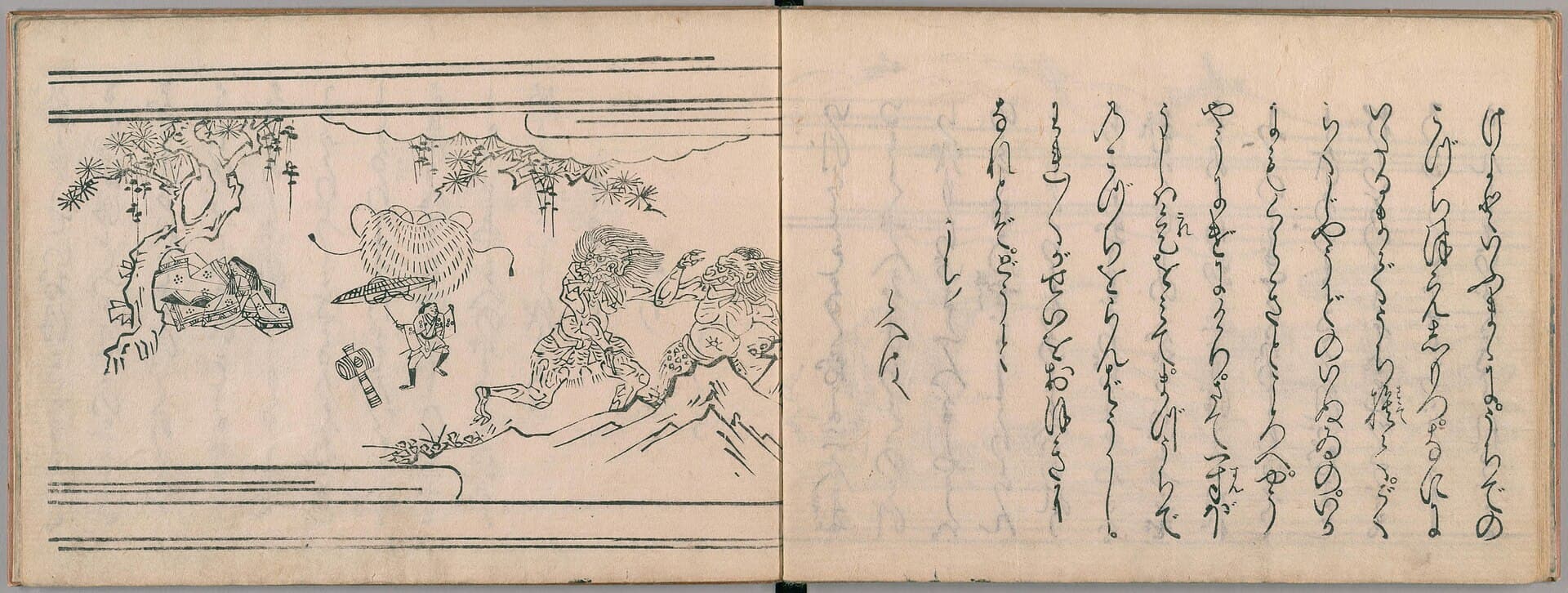
In the rich tapestry of Japanese folklore, "Issun-bōshi" (一寸法師) holds a significant place among the revered tales known as the Otogi-zōshi (御伽草子). These "companion tales," which flourished during the Muromachi (室町時代) and early Edo periods, are a collection of around 400 short stories that encapsulate the ethos of medieval Japan. Alongside Issun-bōshi, tales such as Momotarō, Urashima Tarō, Kintarō, and the tongue-cut sparrow form the core of this genre, reflecting societal values and beliefs. Issun-bōshi, however, is unique in its portrayal of a hero whose diminutive size defies expectations, yet embodies resilience and cleverness.
The tale
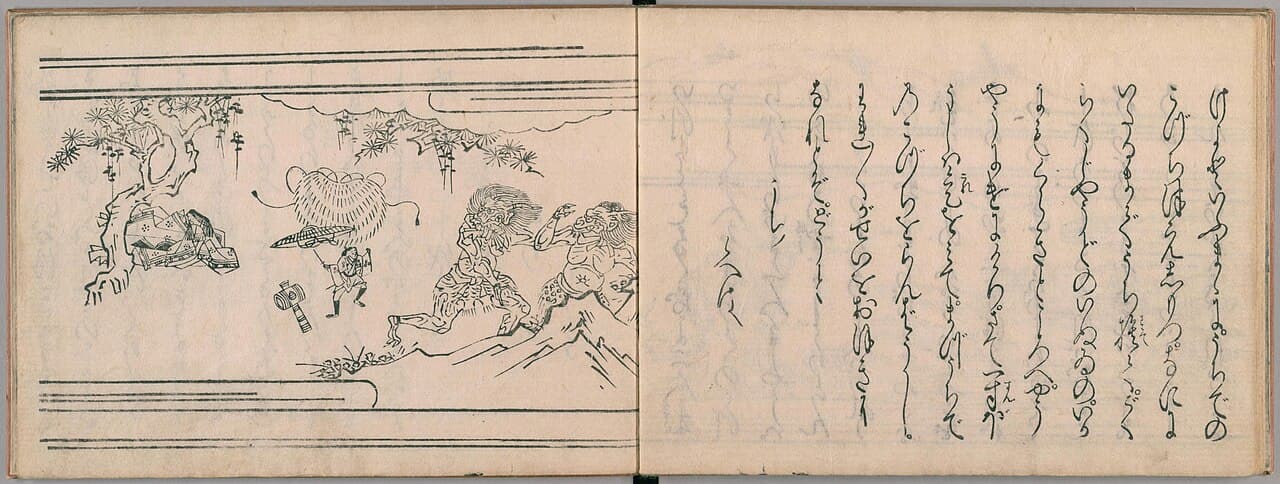
The story of Issun-bōshi begins with an old couple who long for a child. Despite their advanced age, their prayers to the deity of Sumiyoshi are answered, but in an unexpected way. They are blessed with a son who measures only one sun (一寸)—approximately three centimetres—in height. Named Issun-bōshi, or "one-sun monk," the child never grows larger, yet his spirit remains undeterred. As he matures, he decides to set out into the world, determined to make his mark despite his size.
Issun-bōshi arms himself with a needle (針) as his sword, a rice bowl (茶碗) as his boat, and a chopstick as his oar. Thus equipped, he travels to the capital. There, he finds work in a noble household and wins the favour of the lord’s daughter. Soon, he accompanies her on a pilgrimage to a temple, during which they encounter a fearsome demon (鬼). In a display of remarkable bravery, Issun-bōshi leaps into the demon’s mouth, using his needle sword to pierce its insides. The demon, in agony, flees and drops its magical mallet, known as uchide no kozuchi (打ち出の小槌), which can grant any wish when struck.
The daughter uses the mallet, and with a few shakes, Issun-bōshi grows to full size, transforming from a tiny figure into a handsome young man. With his new stature, he marries the daughter, and the couple lives prosperously. The story concludes with the message that true worth and heroism are not measured by size, but by the heart and determination of the individual.
Where the story comes from
The Otogi-zōshi corpus, to which Issun-bōshi belongs, emerged prominently in the late 14th to 17th centuries. These stories, often compiled by Buddhist temple scholars, served both as entertainment and moral instruction. Their creation and dissemination were intimately tied to the cultural and religious milieu of the Muromachi period, where storytelling was a means of imparting values and preserving tradition. The tales were illustrated narratives, making them accessible to a wide audience, from the educated elite to common folk.
Interestingly, the narrative of Issun-bōshi bears a resemblance to European folktales such as "Tom Thumb." Though these stories developed independently, they share the archetype of the tiny hero—a motif that appears in various cultures around the world. This parallel highlights a universal fascination with the idea that the smallest among us can possess great courage and ingenuity, transcending their apparent limitations. Scholars like Skord (1991) and Mulhern (1985) have explored these cross-cultural similarities, noting the independent yet analogous development of these folk traditions.
The vocabulary you'll meet if you read the original
Reading the original Issun-bōshi tale in Japanese involves encountering several key vocabulary items that are essential for understanding. The term 一寸 (issun) refers to the traditional unit of measure, approximately three centimetres, symbolising the hero's small stature. 法師 (hōshi) denotes a monk, reflecting the character's humble beginnings and spiritual connotations. The antagonist, a demon, is called 鬼 (oni), a staple of Japanese folklore known for its menacing appearance.
One of the story's pivotal elements is the 打ち出の小槌 (uchide no kozuchi), the magic mallet that changes Issun-bōshi's fate. This item embodies the transformative power of the tale. The narrative itself belongs to the genre of 御伽草子 (otogi-zōshi), illustrating its roots in medieval Japanese storytelling. Additionally, the setting is tied to the 室町時代 (Muromachi-jidai), contextualising the historical backdrop against which these stories were told. Finally, everyday objects like 茶碗 (chawan) and 針 (hari) are reimagined in fantastical ways, showcasing the creativity embedded in Japanese folklore.
What the tale teaches without preaching
The tale of Issun-bōshi, like many stories within the Otogi-zōshi collection, subtly conveys themes without overt moralising. It rewards the protagonist's perseverance and cleverness over brute strength, aligning with the characteristics of the 昔話 (mukashi-banashi) genre, which often concludes with marriage and material prosperity. These stories, rooted in fairy-tale realism, invite readers into a world where the extraordinary is seamlessly interwoven with the mundane. A rice bowl becomes a boat, a needle a weapon, and demons walk the streets of Kyōto, yet the narrative remains grounded in a familiar reality.
The didactic layer of Issun-bōshi is thin, allowing the story's imaginative elements to shine. It underscores the importance of wit and resilience in overcoming life's challenges, a message that resonates across cultures and time periods. This aspect of the tale aligns with the narrative structures found in other folktales, where ordinary protagonists achieve greatness through resourcefulness and determination, rather than through traditional heroics.
For learners of Japanese, delving into such tales offers a dual benefit: engaging with cultural narratives while enhancing language skills. The vocabulary and structures encountered in these stories provide valuable context for language acquisition, bridging the gap between linguistic competence and cultural literacy.
For those who have reached an intermediate level of Japanese proficiency, particularly those above JLPT N3, tackling a Meiji-era retelling of Issun-bōshi can be an enriching experience. Such versions retain much of the original charm while being accessible to modern readers. The names of objects and the gentle syntactic flow make it an ideal choice for learners seeking to immerse themselves in authentic Japanese literature. According to Kokusai Bunka Shinkokai (1939), these retellings continue to captivate readers with their blend of simplicity and depth.
References
- Skord, V. (1991). Tales of Tears and Laughter: Short Fiction of Medieval Japan. University of Hawai'i Press.
- Mulhern, C. I. (1985). Otogi-zōshi: Short Stories of the Muromachi Period. Monumenta Nipponica.
- Kokusai Bunka Shinkokai. (1939). Issun-bōshi, in Japanese Fairy Tales (Iwaya Sazanami retellings).
Source · Issun-bōshi survives in the medieval Otogi-zōshi corpus and was retold in English by Iwaya Sazanami (1870–1933), whose Japanese Fairy Tales are public domain via Project Gutenberg and the Internet Archive.


