
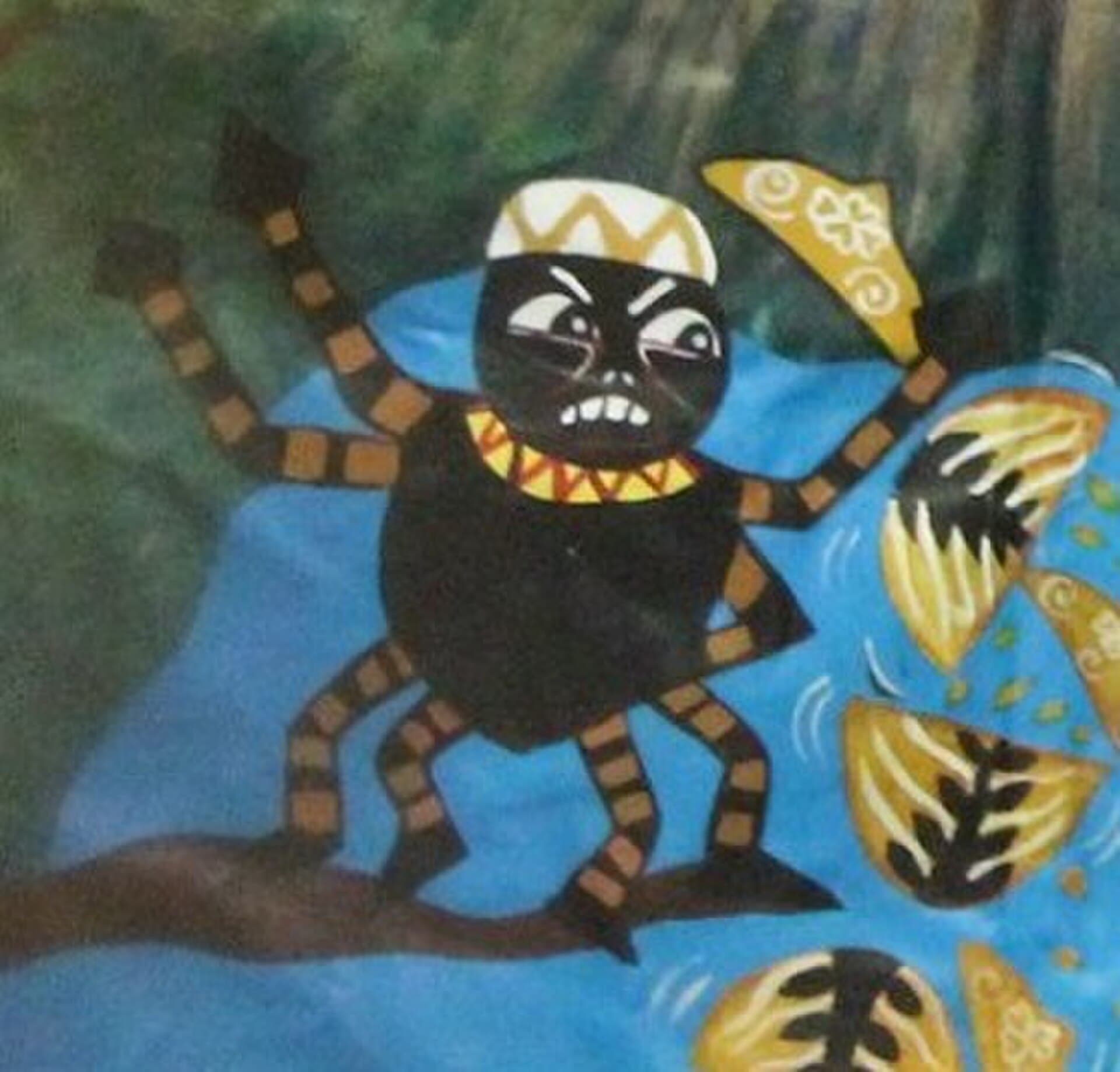
In the pantheon of West African folklore, Anansi, also known as Ananse in his native Akan language, stands as a figure of immense cultural significance. Originating from the Akan people of southern Ghana and Côte d'Ivoire, Anansi is more than just a simple trickster; he is a complex character who embodies both wisdom and folly. Anansi's tales often carry with them lessons disguised under the cloak of his mischief. These stories have crossed the Atlantic, carried by the transatlantic slave trade, and taken root in the Caribbean and the American South. The enduring nature of Anansi's tales lies not only in their entertainment value but also in their role as vehicles of cultural continuity and transmission. In the Caribbean, particularly in Jamaica, Anansi has become "Anancy," while in the American South, he transforms into "Aunt Nancy," showing his adaptability and cultural resilience.
The tale
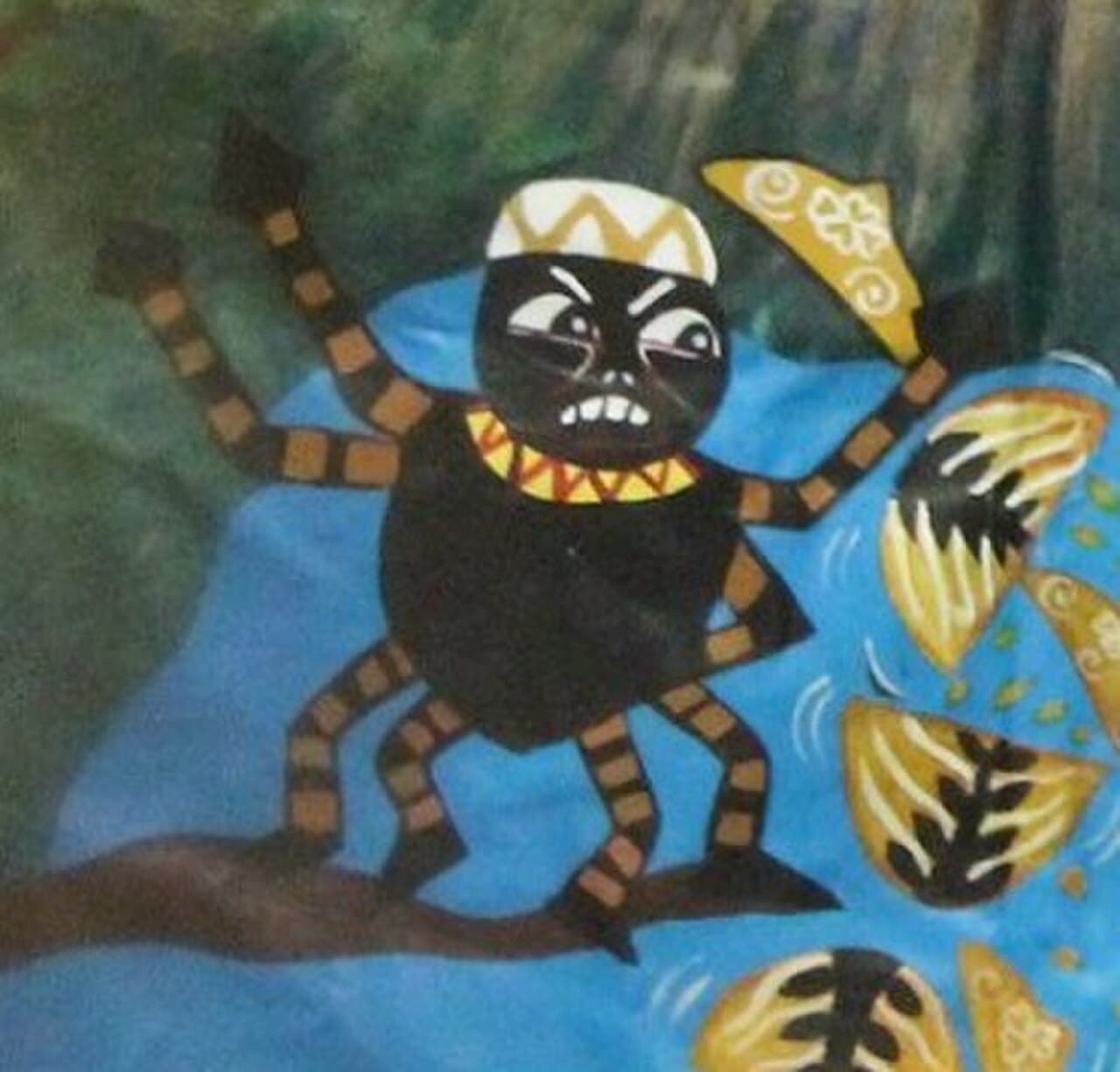
Once upon a time, in the heart of an African village, Anansi the spider devised a grand plan to collect all the wisdom in the world. He believed that by owning all the wisdom, he would become the wisest of all creatures, a feat that would elevate him above all others. Anansi gathered wisdom from every corner of the earth, placing each piece into a large pot. As the pot filled, so did Anansi's ambition. He decided that the pot needed to be hidden in a place where no one else could reach it—at the top of the tallest tree. Anansi tied the pot to his belly and began to climb the towering tree. His movements were awkward, and he struggled to make progress. From below, his young son watched with curiosity. The child called out, "Father, if you tie the pot to your back, you'll have an easier time climbing." Anansi, in his arrogance, dismissed the child's advice at first, but frustration soon got the better of him. In a moment of rage, he hurled the pot from the tree. The pot shattered as it hit the ground, and with it scattered the wisdom he had so painstakingly collected. From that day forward, the wisdom that Anansi had tried to hoard was dispersed among all people, each holding a piece of it, so no one would ever again control it all.
What kind of tale this is

The story of Anansi and the pot of wisdom is a classic example of an etiological folktale—a narrative that explains the origin of a custom, a natural phenomenon, or the nature of the world. In the Akan context, this tale speaks volumes about communal values and the distribution of knowledge. Wisdom, in this tradition, is seen as a tangible substance, one that was once concentrated but is now shared among all people due to Anansi's hubris. This element of the tale highlights a core Akan belief in the communal nature of wisdom, contrasting sharply with the individualistic pursuit embodied by Anansi. Moreover, the tale features a recurring motif in Akan folklore: the fool who corrects the wise one. Here, Anansi's young son plays the role of the wise fool, offering a simple yet profound insight that eludes his father. The child's suggestion represents the voice of common sense and humility, traits that are often undervalued but prove to be crucial. This inversion of roles underscores a cultural lesson on the limits of arrogance and the power of humility, encapsulated within a seemingly simple story.
How the tales travelled
The journey of Anansi's tales across the Atlantic is a testament to the resilience of cultural narratives. During the era of the transatlantic slave trade, people from the Akan regions of Ghana and Côte d'Ivoire were forcibly taken to the Americas. Along with them, they carried their stories, their songs, and their beliefs. In the Caribbean, particularly in Jamaica, Anansi found a new home among the enslaved and later freed communities. The stories were documented by figures such as Louise Bennett-Coverley, affectionately known as "Miss Lou," and Walter Jekyll, who collected them in works like "Jamaican Song and Story" (1907). In the American South, Anansi's tales adapted to their new environment, becoming part of the local folklore. Here, Anansi sometimes transformed into "Aunt Nancy" or "Sister Nancy," a figure who retained the trickster's cunning and wisdom. These stories provided both entertainment and instruction, preserving a cultural identity that was under threat and offering a form of resistance against the cultural erasure imposed by slavery.
The Twi vocabulary you can hear in English
African languages have left their mark on English, particularly through words that made their way into the lexicon via the transatlantic slave trade. However, while some etymologies are clear, others remain speculative. Among the well-supported loanwords, 'okra' stands out, likely originating from the Igbo word ókùrù, with similar forms across West Africa. Another example is 'gumbo,' derived from the Bantu kingombo, reflecting the dish's African roots. The word 'banjo' also has African connections, possibly linked to the Kimbundu word mbanza, a type of stringed instrument. 'Anansi' itself remains unchanged as it crossed into Caribbean English, but not all proposed African roots are as certain. Theories suggesting that words like 'hip,' 'cool,' and 'jive' originate from African languages are intriguing yet contested. Scholars such as Geneva Smitherman, in "Black Talk," and David Dalby, in "The African Element in American English," offer both support and caution, acknowledging the complex interplay of languages and cultures that shaped African American English. Thus, while some words have clear African lineage, others require careful consideration before drawing conclusions.
The Anansi cycle is a remarkable example of how stories endure and evolve, despite the harshest of conditions. These tales survived the brutalities of the Middle Passage and the erasure that slavery imposed on so many other aspects of African culture. In their new homes, these narratives did not merely survive; they thrived, transforming and adapting to new cultural landscapes while retaining their core essence. Anansi's tales are worth engaging with in any of their forms, be it the original Akan stories that breathe with the rhythms of West African oral tradition, the Jamaican versions vibrant with Creole innovation, or the English translations that strive to capture both the mischief and the wisdom embedded within. Each version offers a lens through which to appreciate the durability and adaptability of human storytelling, a testament to the enduring power of narrative across time and space.
References
- Jekyll, W. (1907). Jamaican Song and Story. London: David Nutt.
- Smitherman, G. (2000). Black Talk: Words and Phrases from the Hood to the Amen Corner. Houghton Mifflin.
- Dalby, D. (1972). The African element in American English. In T. Kochman (Ed.), Rappin' and Stylin' Out.
- Anansi article, Encyclopædia Britannica.
Source · The pot-of-wisdom tale circulates in many Akan-language sources and English retellings. The version closest to that retold here appears in Walter Jekyll's Jamaican Song and Story (1907), public domain via Project Gutenberg.


