Every even number greater than 2 can be expressed as the sum of two prime numbers. Take the simplest examples: 4 is 2 plus 2, 6 is 3 plus 3, 8 is 3 plus 5. As the numbers increase, the representations grow more numerous. By the time you reach 10, there are two ways: 3 plus 7 and 5 plus 5. At 12, 5 plus 7 emerges. For 14, you have 3 plus 11 or 7 plus 7. The pattern appears unbreakable. By 100, there are six different representations. By the time the number reaches 1,000, the representations multiply to dozens. And when it scales to a billion, the possibilities climb into the thousands. As of 2024, computational verification extends Goldbach's conjecture to every even integer up to 4 × 10^18—four quintillion. Not a single exception has been found. The conjecture is likely true, yet remains unproven. A proof would stand as one of the most significant accomplishments in number theory. Despite 283 years of the most brilliant mathematical minds trying, it remains beyond reach.
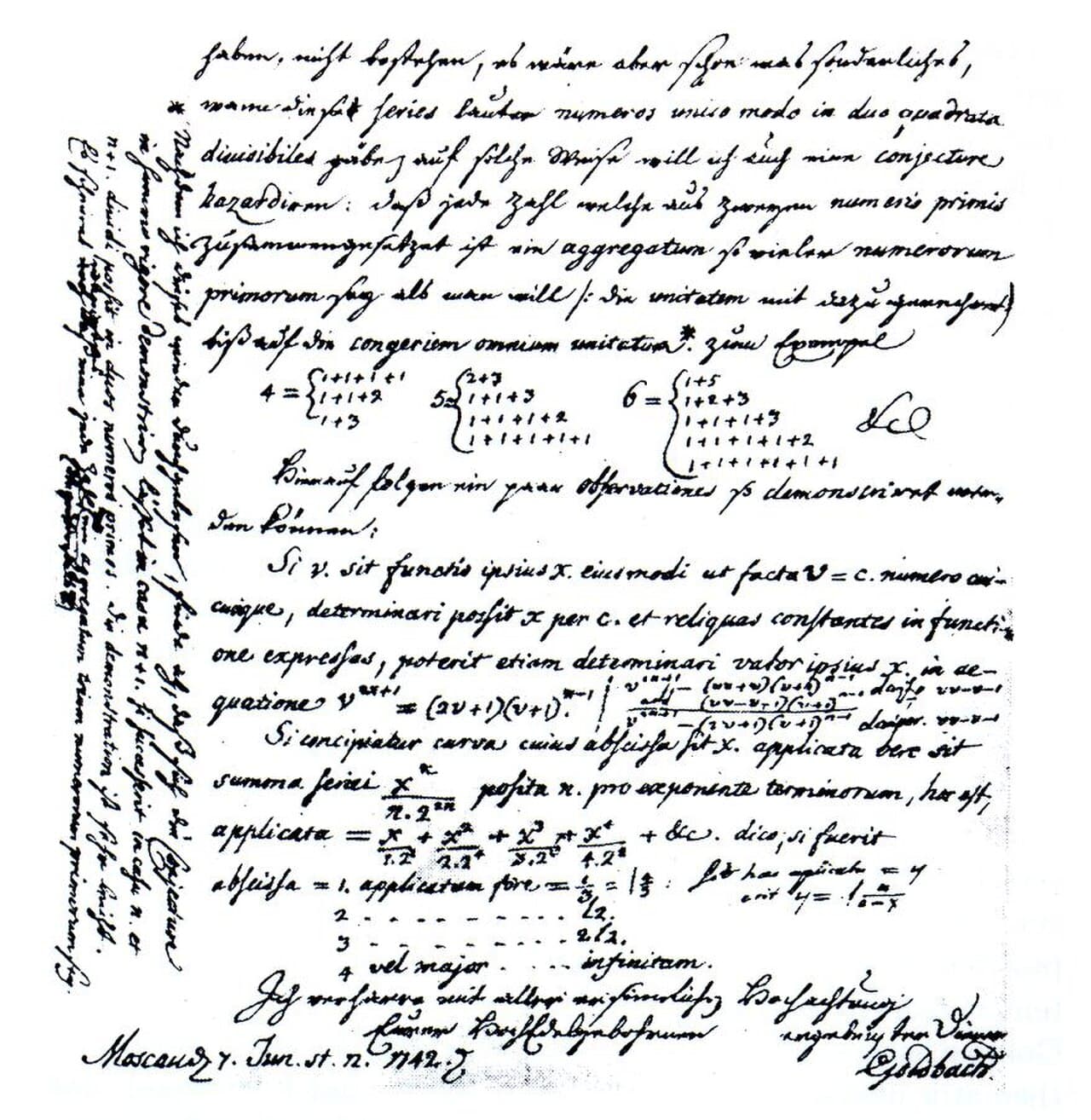
The letter of 7 June 1742
Christian Goldbach, a mathematician of Prussian origin, was working in Saint Petersburg in the early 18th century. His role as the secretary of the Imperial Academy of Sciences and tutor to Tsar Peter II placed him at a unique intersection of academic and royal circles, yet in the mathematical world, he was regarded as a second-tier figure. Despite his standing, Goldbach maintained a correspondence with Leonhard Euler, who was, without question, the preeminent mathematician of his time. On 7 June 1742, Goldbach penned a letter to Euler in Latin, proposing what seemed an innocuous observation: 'I am of opinion that every integer greater than 2 can be expressed as the sum of three primes.' It is important to note that in Goldbach's time, the number 1 was considered a prime, a view not held by modern mathematicians.
Euler's reply, dated 30 June 1742, transformed Goldbach's conjecture into a more elegant form: every even integer greater than 2 is the sum of two primes. This reformulation is the statement we know today as Goldbach's conjecture. Euler expressed his belief in its truth but admitted he had no proof. The exchange between Goldbach and Euler, spanning several years, did not return to this conjecture with any significant focus. The conjecture lay dormant in their correspondence, not gaining real attention until the rise of modern number theory in the late 19th century, when it was unearthed as a mathematical curiosity.
Why this kind of statement is hard to prove
The Goldbach conjecture occupies a challenging niche within number theory due to its nature. It speaks to the additive behaviour of primes—how primes combine through addition. Yet, the intrinsic definition of a prime number is based on multiplication—a prime is a number greater than 1 with no divisors other than 1 and itself. This disjunction between addition and multiplication makes the conjecture especially intractable. There is no direct mathematical mechanism to bridge 'X is prime' with 'X plus Y equals a specific even number'.
The Prime Number Theorem, proven independently by Jacques Hadamard and Charles de la Vallée Poussin in 1896, provides an asymptotic distribution of primes among integers. The Riemann Hypothesis, proposed in 1859 and still unproven, offers insights into the finer structure of this distribution. Despite being foundational for tackling prime-related problems, neither theorem directly addresses Goldbach's conjecture. The British mathematician G. H. Hardy, along with John Littlewood, explored Goldbach in the 1920s, noting that major problems in analytic number theory often hover near the Riemann Hypothesis. Proving them outright demands new methods, a situation that still holds today.
What has been proved
The Hardy-Littlewood circle method, an innovation of the 1920s, stands as the cornerstone for addressing problems involving the sums of primes. This method, discussed in depth by R. C. Vaughan in his book, uses complex analysis to calculate the number of ways a number can be expressed as a sum of primes. When applied to the Goldbach conjecture, it provides partial results, contingent on the truth of the Generalized Riemann Hypothesis.
In 1937, Lev Schnirelmann achieved the first significant unconditional result: every sufficiently large integer can be expressed as the sum of at most some large, specific number of primes. While this was weaker than the strong form of Goldbach's conjecture, it was a groundbreaking moment, demonstrating that analogous statements were possible. In the same year, Ivan Vinogradov proved the 'weak' or 'odd' Goldbach conjecture, showing that every sufficiently large odd integer can be expressed as the sum of three primes. The threshold for 'sufficiently large' was initially high, but Olivier Ramaré and later Harald Helfgott, whose work completed in 2013-2015, extended the proof to cover all odd integers greater than 5. The strong Goldbach conjecture, however, remains unresolved.
What computers have done
Computers have played a vital role in the ongoing verification of Goldbach's conjecture. Pál Erdős, a towering figure in 20th-century mathematics, kept a keen eye on computational efforts to test the conjecture. As technology evolved, the capacity to verify the conjecture for larger numbers grew. Advances in algorithms and the capability of distributed computing systems have been pivotal. The most significant verification record, published by Oliveira e Silva, Herzog, and Pardi in 2014, confirmed the conjecture for all even integers up to 4 × 10^18.
The method of verification involves identifying, for each even integer N, at least one pair of primes (p, N-p) such that both numbers are prime. The process has never encountered a failure. As N becomes larger, the number of possible prime pairs also increases, reducing the likelihood of encountering an exception if the conjecture were false. Despite the strength of this computational evidence, it does not equate to a mathematical proof. A genuine counterexample, were it to exist, might only appear beyond the reach of any foreseeable computational effort. History offers cautionary tales, such as the Pólya conjecture, which held true for many numbers before an unexpected counterexample was found.
Why the problem persists
The enduring nature of Goldbach's conjecture can be ascribed to several key factors. Firstly, the question itself is profound, probing the intricate relationship between the additive and multiplicative properties of integers. Solving it would likely introduce new mathematical techniques that could unlock other unsolved mysteries in number theory. Secondly, the conjecture is straightforward. Its clarity is unmatched; the statement is simple and accessible to all mathematicians, avoiding the complexities of defining sophisticated terms or choosing between axioms.
Finally, the conjecture has withstood every assault from existing mathematical strategies. Techniques like the circle method and various sieve methods provide insights but fall short of a full proof. Even the breakthroughs in additive combinatorics by mathematicians like Terence Tao and Ben Green have not sufficed to settle the Goldbach conjecture. In a 2015 lecture, Gerhard Frey speculated that the eventual resolution might arise from unexpected quarters—perhaps from advances in arithmetic geometry or theoretical computer science, rather than the current toolkit of analytic number theory.
What the problem is worth
In 2000, during a promotional campaign for the novel 'Uncle Petros and Goldbach's Conjecture' by Apostolos Doxiadis, Faber & Faber offered a million-dollar prize for a proof within two years. The prize went unclaimed, and the challenge expired without a resolution. The more renowned Clay Mathematics Institute's Millennium Prize Problems, also announced in 2000, did not include Goldbach's conjecture among the seven chosen. The problems selected were those like the Riemann Hypothesis, which promises to resolve numerous subordinate issues upon proof.
The absence of Goldbach from the list reflects a professional consensus: while the conjecture is a famous unsolved problem, it lacks the systemic importance that some other problems carry. For instance, the Riemann Hypothesis, if resolved, would impact many aspects of number theory and beyond, settling issues like a stronger form of the Prime Number Theorem. A proof of Goldbach, however profound, would primarily settle Goldbach itself. The depth is significant, but its broader mathematical implications, though undoubtedly illuminating, are more limited.
Sit down with a sheet of paper. Take any even number. Find two primes that sum to it. Goldbach's conjecture says that you will always succeed. So far, in every case ever tested by anyone, you have. The conjecture is the kind of statement that, if a child asks the question, you can teach them the question in five minutes and the depth of the question in fifty years. There is no mathematical content in this article that a determined sixteen-year-old could not understand. There is also no path to a proof that any of the world's leading mathematicians can see, and there has not been for nearly three centuries. The combination is what makes Goldbach what it is: a problem any reader can grasp; a problem the field has not yet learned how to solve; a problem that, when it is eventually proved, will probably illuminate the gap between the additive and multiplicative structures of the integers in a way we cannot currently anticipate. It will be solved, presumably, eventually. The mathematician who does it will probably be young, will probably bring methods nobody currently expects, and will probably not have been born when this article appears. Goldbach is waiting.
References
- Helfgott, H. A. (2014). The ternary Goldbach problem. arXiv:1404.2224.
- Oliveira e Silva, T., Herzog, S., & Pardi, S. (2014). Empirical verification of the even Goldbach conjecture and computation of prime gaps up to 4·10^18. Mathematics of Computation, 83, 2033–2060.
- Vaughan, R. C. (1997). The Hardy-Littlewood Method. Cambridge University Press.
- Wang, Y. (2002). The Goldbach Conjecture (2nd edition). World Scientific.