In March 1946, Reginald Sprigg, a young geologist of twenty-seven years, found himself in the remote Flinders Ranges of South Australia. His task was straightforward: map the old Ediacara silver mine, a site with little promise, nestled roughly 600 kilometres north of Adelaide. The mine lay in a landscape of ancient rocks, deeply weathered sandstone dating back to the late Precambrian. On an unremarkable afternoon, while taking a break for lunch, Sprigg sat on a flat slab of this sandstone. As he turned it over, he encountered impressions that would challenge the scientific beliefs of his time. These impressions were circular, sub-radially symmetric, and spanned several centimetres across. To an observer, they might seem reminiscent of jellyfish. Yet, jellyfish, being soft-bodied, seldom fossilised, and the rock's age meant these impressions predated known complex life forms, or so conventional wisdom insisted. The sandstone was Precambrian, older than 540 million years, a time before the Cambrian period when life was believed to have truly complexified. Sprigg, aware of the prevailing geological consensus, understood he had stumbled upon something seemingly impossible. He meticulously photographed these impressions, collected samples, and documented his findings. In 1947, he published a description of these fossils in the Transactions of the Royal Society of South Australia. Despite this, his discovery was largely dismissed for over a decade, deemed too anomalous to integrate into existing scientific narratives. Only when Martin Glaessner of the University of Adelaide revisited the Flinders Ranges material in the late 1950s, comparing it with similar fossils from Newfoundland, Namibia, and Russia, did the field begin to grasp the significance of Sprigg's discovery. Sprigg had uncovered the Ediacaran biota, evidence of the earliest substantial complex life, captured in rock formations dating from 575 to 539 million years ago. These organisms predated the Cambrian explosion by approximately 40 million years and bore little resemblance to any extant life forms.
What the fossils show
Since Sprigg's initial find, Ediacaran fossils have been identified on every continent, revealing a global distribution of this ancient biota. Key localities have emerged as critical to understanding these organisms: the Ediacara Hills in South Australia, which lent their name to the period; Mistaken Point in Newfoundland, where rocks about 565 million years old showcase some of the oldest and most diverse early Ediacaran assemblages; the White Sea coast of Russia, which houses younger fossils, around 555 to 550 million years old, displaying the highest complexity of Ediacaran body forms; and the Nama Group in Namibia, revealing the latest Ediacaran assemblage at approximately 545 to 538 million years old, including the first signs of biomineralisation in some lineages.
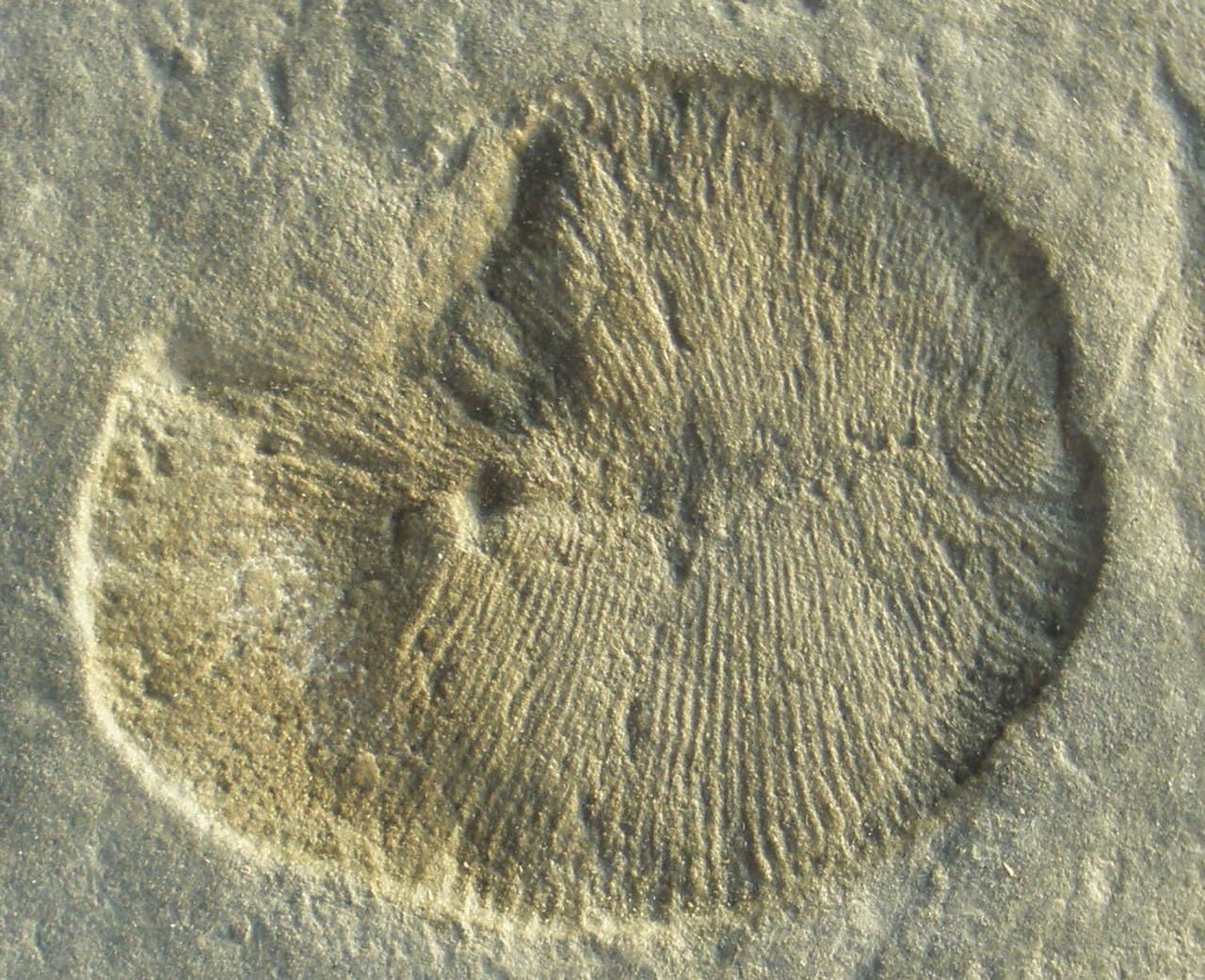
The organisms preserved in these sites exhibit unique body plans, unlike any modern animal phylum. Typically ranging from a few centimetres to a metre across, these soft-bodied entities lacked mouths, guts, eyes, limbs, or other recognisable animal features. Among them are the frond-like 'rangeomorphs' such as Charnia and Bradgatia, which branched in fern-like patterns. Discoidal forms like Aspidella and Cyclomedusa, as well as segmented quilted ovoids such as Dickinsonia, perhaps the most renowned Ediacaran fossil, add to the diversity. Spindle-shaped forms such as Beothukis, and more intricate types like Kimberella, which is argued to have possessed a mouth and foot suggestive of a stem-group mollusc, further complicate classification. Collectively, these organisms represent a separate evolutionary experiment in multicellular complexity. They thrived for approximately thirty-five million years before largely vanishing, leaving behind no clear modern descendants. Some may share distant ties with extant sponges or cnidarians, yet most remain enigmatic, hinting at a distinct chapter of life's history.
What they were doing
Understanding the lifestyle of the Ediacaran organisms is fraught with challenges. These creatures inhabited the shallow marine environments, typically depths ranging from twenty to two hundred metres, a setting akin to the modern continental shelf. They were sessile, anchored to or embedded in the seabed, devoid of any hard parts like shells, skeletons, teeth, or spines. Their preservation owes itself to a unique condition known as 'death-mask' preservation, occurring when these soft-bodied organisms settled into dense bacterial mats on the sediment surface. These mats facilitated the sealing of impressions as the underlying sediment became buried over time. The presence of these bacterial mats, known as 'matground' surfaces, is often observed in Ediacaran-age sediments.
The nutritional strategies of these organisms are subjects of speculation. Many lacked visible feeding structures, likely absorbing dissolved nutrients directly through their body surfaces in a mode called osmotrophy, a strategy still employed by some bacteria today. Notably, rangeomorphs from Mistaken Point exhibit fractal branching patterns that maximise surface area, indicating osmotrophy might have been a primary nutritional mode for significant Ediacaran lineages. Kimberella, on the other hand, displays grazing traces preserved in the surrounding rock, suggesting more active feeding behaviour. The mode of reproduction among these organisms remains elusive. While some patterns suggest colonial budding, others imply sexually produced offspring populations. Trace fossils of movements, such as tracks and burrows, are scarce before about 555 million years ago, becoming more common only towards the end of the Ediacaran period. Movement, when it occurred, was predominantly limited to gliding or grazing along the surface rather than burrowing into sediment.
Why they disappeared
The enigmatic disappearance of the Ediacaran biota from the fossil record, approximately 539 million years ago, coincides with pivotal changes in the Earth's environment and ecology. This disappearance marks the boundary just before the onset of the Cambrian period, a time heralded for its explosive diversification of animal life. Two critical changes are noted at this junction: a significant chemical alteration in the global ocean, manifesting as a sharp decline in seawater carbon-13 isotopes—an event known as the Basal Cambrian Negative Carbon Isotope Excursion—hinting at a major disruption in the carbon cycle, and the emergence of the first animals possessing hard skeletons, predatory capabilities, and the ability to burrow into the sediment.
The interrelation between these events is a matter of intense study. The novel predatory and burrowing capabilities introduced ecological pressures that the Ediacaran organisms, with their soft bodies and specific ecological niches, could not withstand. The bacterial mats that once provided stable substrates for Ediacaran existence were disrupted by these new burrowing animals, eliminating the conditions necessary for 'death-mask' preservation. Additionally, the arrival of predators likely presented a challenge against which the Ediacaran biota had no defence mechanisms. This transition saw the extinction of most Ediacaran lineages, with only a few possibly surviving in altered forms, perhaps giving rise to modern cnidarians and sponges. The subsequent Cambrian explosion, which saw the rapid appearance of nearly all modern animal phyla over approximately 25 million years, is viewed as the second wave of complex life, distinct from the Ediacaran ecosystem. While the Cambrian era brought the first recognisable animal ecosystem, the Ediacaran period represents the initial flourish of complex multicellular organisms, now largely vanished.
What they actually were
The taxonomic classification of the Ediacaran biota is one of the most intriguing and unsettled questions in palaeontology. The debate has spurred numerous theories, with Adolf Seilacher's 'Vendobionta' hypothesis (1989-1992) standing out as particularly provocative. Seilacher posited that the Ediacaran organisms represented a distinct kingdom, fundamentally unrelated to modern animals—a unique experiment in multicellular evolution that left no direct descendants. This hypothesis challenged conventional views, prompting significant discourse and investigation.
Others, such as Mikhail Fedonkin and colleagues, have proposed that certain Ediacaran forms belong within modern animal phyla. Dickinsonia, for example, has been suggested as a stem-group bilateran, while Kimberella has been argued to be a precursor to molluscs. Charnia may fit as a stem-group cnidarian or even an early animal. Supporting this, molecular phylogenetic studies, which utilise DNA sequences from living organisms, suggest the origin of bilateran animals lies within the Ediacaran period, approximately 600 to 650 million years ago. Further evidence comes from a 2018 Science paper by Bobrovskiy et al., which identified cholesteroid biomarkers in Dickinsonia-bearing sediments, consistent with early animal life, providing chemical validation that some Ediacarans were indeed animals. The prevailing cautious consensus is that the Ediacaran biota likely comprised both early animals and non-animal multicellular organisms, the latter of which defy clear classification within modern biological paradigms. The once-dominant 'separate kingdom' theory has waned, with current efforts focusing on untangling which Ediacaran species can be connected to modern lineages.
How they are preserved
The preservation of Ediacaran fossils is as remarkable as it is rare, facilitated by the unique 'death-mask' conditions that existed during their time. These soft-bodied organisms were enshrined in fine sediments, later covered by bacterial mats. The decomposition of these mats precipitated minerals onto the organisms' soft tissues, creating a thin replica that was subsequently encased within the rock. For such preservation, specific environmental conditions were necessary: a stable, shallow-marine seafloor; widespread bacterial mat coverage, implying an absence of grazing and burrowing animals; consistent sedimentation rates; and water chemistry conducive to mineral precipitation on organic surfaces.
These conditions were prevalent during the late Precambrian but vanished with the advent of the Cambrian period, when newly evolved animals began to graze and burrow, disrupting bacterial mats and altering sediment dynamics. The Ediacaran fossil record, therefore, exists as a testament to both the biological characteristics of the Ediacaran organisms and the unique sedimentary conditions of their era. The geological record is, in part, a product of these rare preservation conditions, which once lost, meant no similar record of soft-bodied biotas could be sustained in subsequent periods. This unique window into ancient life underscores the singularity of the Ediacaran world, both in its biological makeup and the peculiarities of its geological preservation.
What this tells us about the structure of evolution
The transition from the Ediacaran to the Cambrian period remains one of the most scrutinised events in evolutionary history, offering profound insights into the nature of life and its complexities. One of the primary lessons is that complex multicellular life is not a predetermined outcome in evolution. Multicellularity has independently arisen at least twenty-five times within the eukaryotic evolutionary tree—among animals, plants, fungi, brown algae, red algae, and various smaller lineages—yet only a few instances have led to ecosystems as intricate as those dominated by animals. The Ediacaran biota represents one such evolutionary experiment that did not persist beyond its ecological time frame.
Moreover, the extinction of the Ediacaran biota is not necessarily indicative of failure. These organisms thrived in seafloor ecosystems for 35 million years—longer than the entire history of placental mammals. Their disappearance coincided with ecological shifts they could not adapt to, rather than an intrinsic flaw in their biological design. Additionally, the seemingly abrupt appearance of animal phyla during the Cambrian is partly a reflection of preservational biases and partly a genuine biological event. Stem-group lineages of major phyla likely existed during the Ediacaran, but their soft-bodied nature left scant fossil evidence. The Cambrian 'explosion' marks the point where these lineages evolved hard parts, becoming readily fossilisable. Thus, the history of life predates the fossil record as we readily interpret it, with the visible record beginning where robust preservable features appear.
Mistaken Point in Newfoundland stands as one of the most significant sites for understanding the Ediacaran biota. As a UNESCO World Heritage site since 2016, this location offers a glimpse into some of the oldest substantial Ediacaran assemblages, preserved on the bedding planes of volcanic ash dated with uranium-lead methods to 565 million years ago. Visitors to this ecological reserve can witness the rangeomorph fronds and discoidal forms etched in the rock, impressions enduring six hundred million years of geological processes. Here, one stands before one of the oldest direct images of complex life on Earth. While older fossils exist, primarily of single-celled organisms, the fossils at Mistaken Point represent the earliest known substantial assemblage where the body plans are recognisably those of complex organisms. The Ediacaran biota marks the inaugural chapter of complex life, a chapter concluding before the Cambrian period began.
References
- Sprigg, R. C. (1947). Early Cambrian (?) jellyfishes from the Flinders Ranges, South Australia. Transactions of the Royal Society of South Australia, 71, 212–224.
- Bobrovskiy, I., et al. (2018). Ancient steroids establish the Ediacaran fossil Dickinsonia as one of the earliest animals. Science, 361(6408), 1246–1249.
- Seilacher, A. (1992). Vendobionta and Psammocorallia: lost constructions of Precambrian evolution. Journal of the Geological Society, 149(4), 607–613.
- Narbonne, G. M. (2005). The Ediacara Biota: Neoproterozoic Origin of Animals and Their Ecosystems. Annual Review of Earth and Planetary Sciences, 33, 421–442.