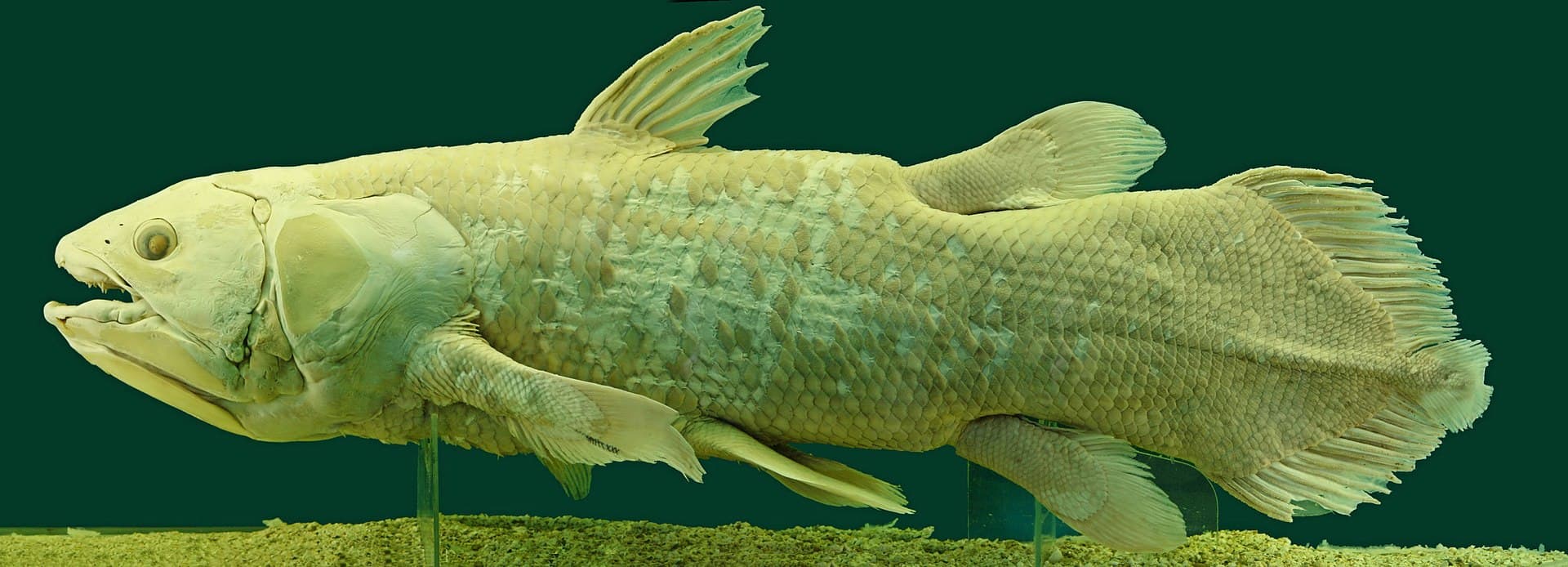
On the 22nd of December, 1938, at the docks of East London on South Africa's eastern Cape coast, the trawler Nerine unloaded its catch from the mouth of the Chalumna River. The captain, Hendrik Goosen, had an arrangement with Marjorie Courtenay-Latimer, the 31-year-old curator of the East London Museum, granting her first access to any unusual specimens for her museum's natural history collection. As Courtenay-Latimer sifted through the mound of bycatch, her gaze fell upon a creature that defied her experience and expectation. There, amidst the pile, lay a deep blue fish, approximately 1.5 metres in length, heavily armoured with thick, ridged scales. Its fins were peculiar, fleshy lobes more akin to stubby limbs than traditional fish fins. Most strikingly, its tail was trilobate, an unusual feature compared to the standard two-lobed tails of most fish. Realising the rarity of her find, she arranged for it to be transported to the museum in a taxi, having been turned away by the East London city refrigerator. Courtenay-Latimer sent a telegram to the closest expert she knew, J. L. B. Smith, a chemistry lecturer at Rhodes University in Grahamstown, who studied fish as a serious hobby. Unfortunately, the telegram took ten days to reach him, delayed by the Christmas holidays.
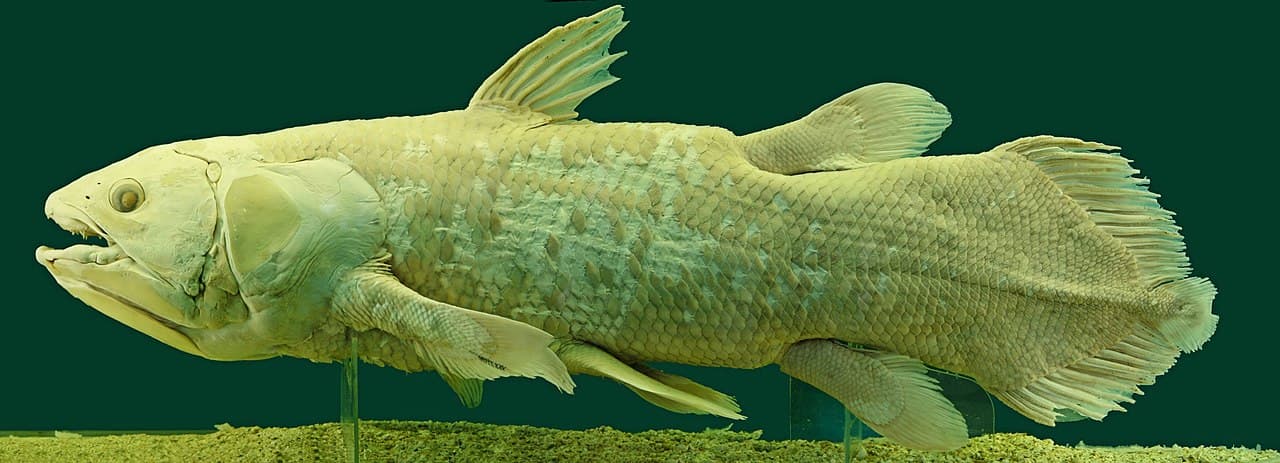
What J. L. B. Smith saw

When J. L. B. Smith finally received Marjorie Courtenay-Latimer's telegram on the 3rd of January, 1939, the fish's internal organs had already decomposed—refrigeration was unavailable, and a local taxidermist had preserved only the skin and skeleton. Despite the specimen's state, Smith travelled to East London, driven by the tantalising possibility that the fish was of significant importance. Upon examining the preserved fish, Smith later wrote, 'I would have known that fish anywhere as a coelacanth, even from a fragment.' Prior to this discovery, coelacanths were considered to exist solely in the fossil record, with the most recent dating back 65 million years to the end of the Cretaceous period. Paleontologists had long assumed that these fish had disappeared along with the non-avian dinosaurs. Smith named the fish Latimeria chalumnae, in honour of Courtenay-Latimer and the Chalumna River mouth. His announcement in the journal Nature in March 1939 marked one of the most discussed zoological finds of the century.
The identification of the coelacanth as a living species was not merely a moment of scientific curiosity; it carried profound implications for our understanding of evolutionary history. The coelacanth is a member of the Sarcopterygii, the lobe-finned fishes, a group that includes the ancestors of all tetrapods—land vertebrates that encompass amphibians, reptiles, birds, and mammals. Modern sarcopterygians are represented primarily by lungfishes, with coelacanths being their only other known lineage. The discovery of a living coelacanth presented a rare opportunity to study a distant relative of the fish lineages that gave rise to land-dwelling vertebrates. Its lobed fins, complete with bones and muscles in a configuration roughly analogous to tetrapod limbs, offer a glimpse into an evolutionary stage closer to the emergence of terrestrial vertebrates than any other living fish. However, it is crucial to note that coelacanths swim rather than crawl, and their fins are not used for walking.
Why it mattered
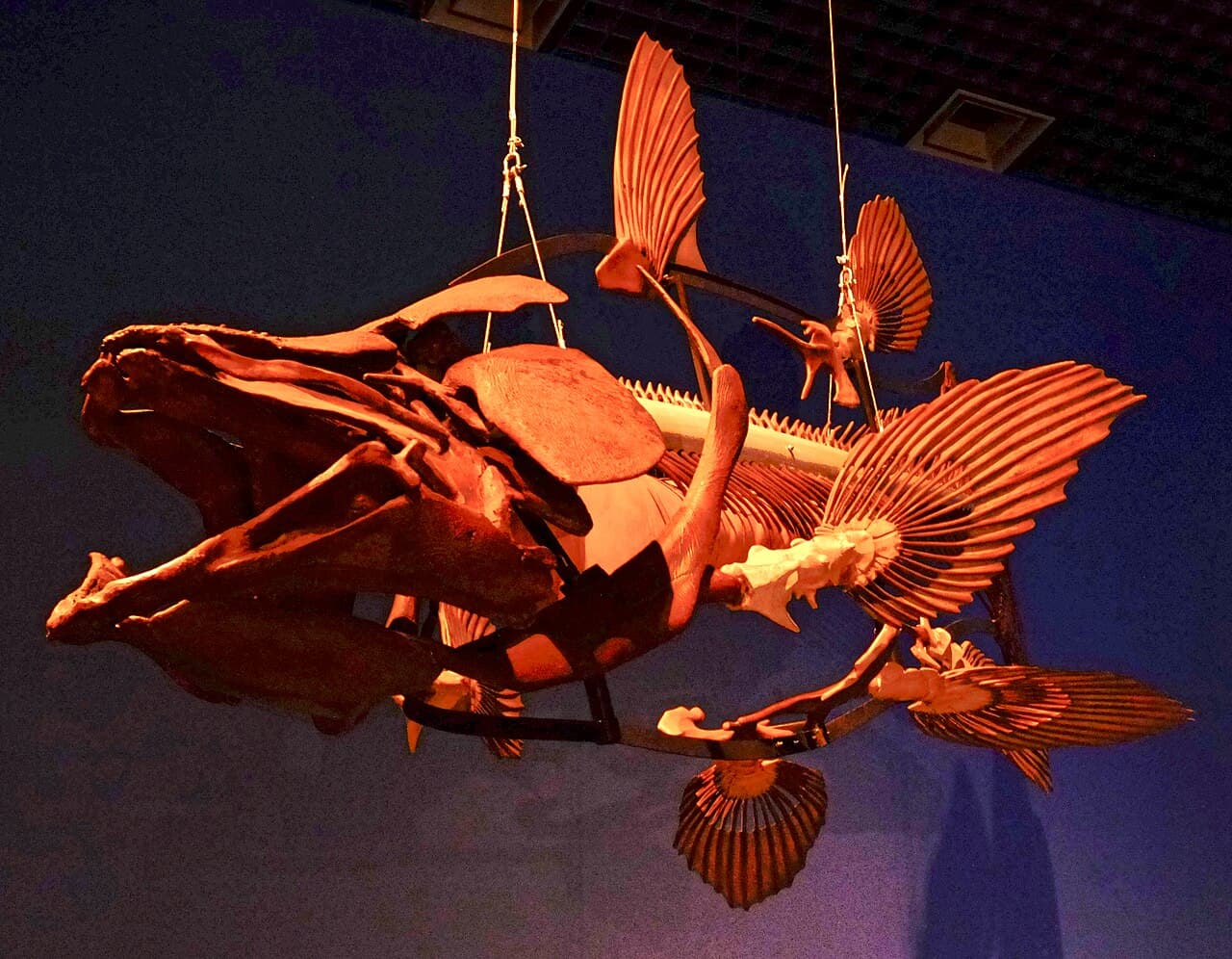
The evolutionary significance of the coelacanth lies in its status as a sarcopterygian—a lineage that includes the forerunners of all land vertebrates. Although modern sarcopterygians are mostly represented by lungfishes, the coelacanth's existence extended this group into a fascinating evolutionary thread. Approximately 390 million years ago, the sarcopterygian lineage split, with one branch leading to the terrestrial vertebrates. The living coelacanths, therefore, represent a distinct branch of this evolutionary tree, providing insights into the early stages of vertebrate evolution. The lobed fins of the coelacanth are equipped with bones and muscles arranged in a way that offers a glimpse into the form that early tetrapod limbs might have taken. While these fins are not used for terrestrial locomotion—they are adapted for swimming in the deep—their structure is invaluable for understanding the morphology of early vertebrate limbs. The 1938 specimen was a rare window into a time when fish were experimenting with the basic body plan that would eventually allow vertebrates to colonise land.
Fourteen-year search for a second specimen
After the initial discovery of the coelacanth, Smith embarked on a fourteen-year quest to locate a second specimen. He distributed leaflets across the coastal communities of southeast Africa, written in English, French, and Portuguese, offering a reward for any unusual deep-water fish that was brought ashore. The leaflets bore fruit in December 1952 when Ahmed Hussein, a fisherman in the Comoros Islands, specifically on Anjouan, caught a coelacanth using a hook and line at around 200 metres depth. Eric Hunt, a French naturalist residing on the island, quickly informed Smith via telegram. In a dramatic turn of events, Smith appealed to South African Prime Minister D. F. Malan, who authorised a military aircraft to transport Smith to the Comoros. Upon arrival, Smith confirmed the specimen as another Latimeria chalumnae, solidifying the existence of a surviving population of coelacanths. The confirmation of a second specimen, coupled with the involvement of international and national entities, underscored the significance of the discovery and the sense of urgency surrounding the study of these ancient fish.
Where they live
The discovery of the second specimen in the Comoros Islands revealed key insights into the habitat of modern coelacanths. These fish inhabit steep, volcanic underwater slopes at depths ranging from 100 to 400 metres, where submarine lava caves provide shelter along the western Indian Ocean. The Comorian population was the first known community of coelacanths. In 1997, a second, distinct species was discovered in Indonesia by Mark Erdmann at a fish market in Manado, North Sulawesi. This species, named Latimeria menadoensis, resides in similar deep underwater caves off Sulawesi, separated from the Comorian population by approximately 10,000 kilometres and around 30 million years of independent evolution. Coelacanths are characterised by their slow growth and reproduction. They give live birth—a rarity among fish—with gestation periods lasting about three years, the longest of any vertebrate. According to growth-ring analysis of their scales, published by Kélig Mahé and colleagues in 2021, these creatures can live up to 100 years or more, further underscoring their unique biological traits.
Why this lineage survived
The straightforward explanation for the apparent 65-million-year fossil gap is a shift in habitat. Most fossil coelacanths come from shallow-water deposits, but modern coelacanths reside in deep, cave-like environments in vertical lava walls, habitats that are notoriously poor at preserving bones. This absence of fossils from such environments likely led to the erroneous conclusion that the coelacanth lineage had gone extinct. Rather than actual extinction, the lineage simply left no fossil record for the same reasons many deep-sea organisms are underrepresented in the fossil record. The rediscovery in 1938 did not signify a resurrection but highlighted the limitations of relying solely on the fossil record to infer extinction. It underscored the possibility that other species presumed extinct might still persist in unexplored niches of the Earth.
What makes the 1938 find rare is not merely the survival of a lineage but rather the confluence of circumstances that led to its rediscovery. The coelacanth has been celebrated as a 'living fossil' for decades, but this framing oversimplifies the narrative. Coelacanths have evolved along their own lineage in deep cave environments where environmental pressures have remained relatively stable. The rarity in 1938 lay in the alignment of several factors: a knowledgeable museum curator in Marjorie Courtenay-Latimer, a fisherman in Hendrik Goosen willing to report his unusual catch, a working trawler venturing into deep waters, and the perseverance of J. L. B. Smith, who had the academic courage to challenge the prevailing scientific consensus. The subsequent 1952 expedition to the Comoros completed the proof, demonstrating that the lineage was not lost, only overlooked. The coelacanth's story invites us to reconsider how much of the natural world remains unexplored, hidden in the depths, awaiting discovery.
References
- Smith, J. L. B. (1939). A living fish of Mesozoic type. Nature, 143, 455–456.
- Smith, J. L. B. (1956). Old Fourlegs: The Story of the Coelacanth. Longmans, Green.
- Erdmann, M. V., Caldwell, R. L., & Moosa, M. K. (1998). Indonesian 'king of the sea' discovered. Nature, 395, 335.
- Mahé, K., et al. (2021). New scale analyses reveal centenarian African coelacanths. Current Biology, 31(16), 3621–3628.